
How Political Crisis Shapes Romania's Art Scene [ director's cut ]
![How Political Crisis Shapes Romania's Art Scene [ director's cut ]](https://storage.ghost.io/c/3c/de/3cde9905-117e-46f2-9117-6a158b5813d1/content/images/size/w1200/2026/05/YAP-studio---REDperformance23-04-67.JPG)
Director's cut of RAD Art Fair coverage for Ocula Magazine, published May 22, 2026
The following is my director's cut version of a recently published piece for Ocula Magazine, it includes deleted scenes, making of and off screen action complete with un-fact-checked takes and rabbit-holes. Thank you the generous artists and curators I met in Romania that warmly invited me into their fascinating and vibrant arts community. Thank you Ocula Mag for spotlighting the Politics of the Romanian Art Scene.
Touch down at Henri Coandǎ International and hop the train to town. I take in expansive farm land, tanker train cars and disparate villages on the outskirts of the city. On a dirt road next to the track I spot two guys in track suits sitting on the roof of their suped up street racer crushing Ursus beers and heckling the train as we roll by. I scramble for my camera but miss the shot. For the rest of my time in Bucharest I keep my trusted 2010s point-n-shoot at the ready. This place is too damn photogenic—with its Ottoman era ornamentation, Francophile period "Little Paris" wrought iron details and hulking "commie blocks"–and I want to remember it all. Welcome to Romania.
I airdropped into Bucharest on a hunch: conventional art world power nodes are shifting, if not spinning out altogether. As artist and podcaster Joshua Citarella proposes in his recent Carrier Bag essay A multipolar Art World?, the once-hegemonic institutional structures of the West and the resulting homogeneity of the contemporary artworld are breaking down, due to a lack of funding, import tariffs and cultural boycotts (or what Citarella cites as ‘the end of globalization’). This breakdown, however, is giving way to new collector bases and alternate spheres of influence: fabrication centers, new museums, and the wealthiest art collectors are increasingly more likely to be found in China than in the US. As I landed in Bucharest for the Romanian Art Dealers (RAD) Art Fair this April, I was looking to immerse myself in the art scene of a city positioned politically and geographically between the conflicting poles of the world’s superpowers, and to get a temperature check at an art event gaining significance in this new, multipolar world.
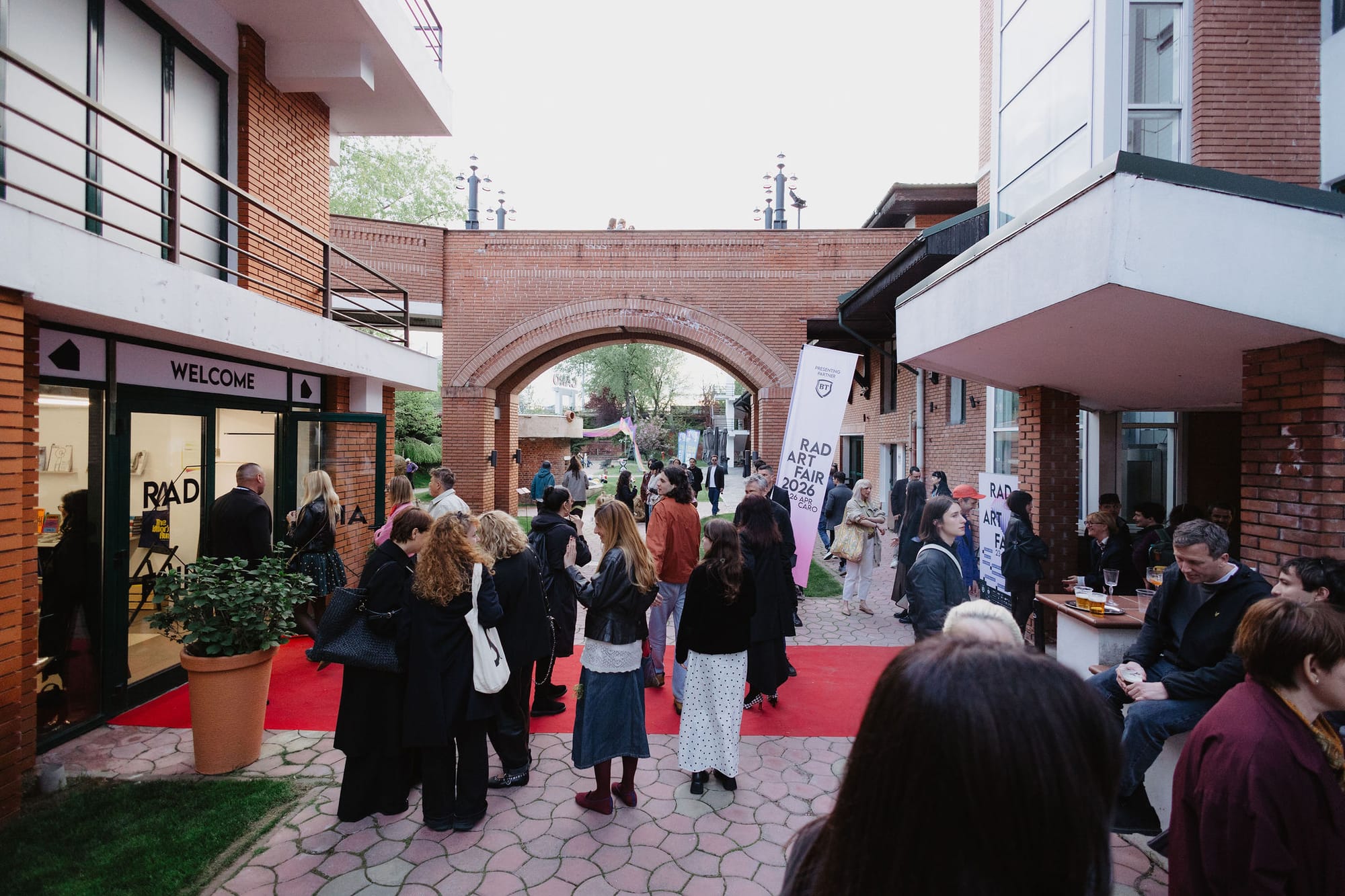
Little did I know that just a week after the fair, multipolarism would spill over from geopolitical discourse to floor of the Romanian parliament, as the country’s far-right and (so-called) Socialist Democratic (PSD) parties would form an alliance to pass a vote of confidence of the centrist EU-supporting Prime Minister, Ilie Bolojan, thus dissolving the reformist government. Political instability is all too familiar for Romanians, who have seen eleven elected PMs since the constitutional crisis in 2012 (involving a critical political standoff between center-right President Traian Băsescu and center-left Prime Minister Victor Ponta). And while in the U.S., the rise of democratic socialist leaders like Zohran Mamdani has seemed like a cause for celebration, here, it means something else, according to artist Andrei Nițu: "The PSD has nothing to do with social democrat politics. It's the party that all the leaders of the corrupt Communist government joined after the fall of communism… All the people that have roles in this party are only there for the position of power, so that they can tie connections with other mafia families. It is the essence of the failure of Romanian politics.”
The no confidence vote – described to me by locals as “a tragedy no one wants” – marks the first major win for the country's growing far-right movement. With this developing context in mind, I returned to my experience at the fair with soft eyes. I want to embrace this moment, in all its complexity, holding it as a floodlight against the reactionary darkness of a right-ward national swing.
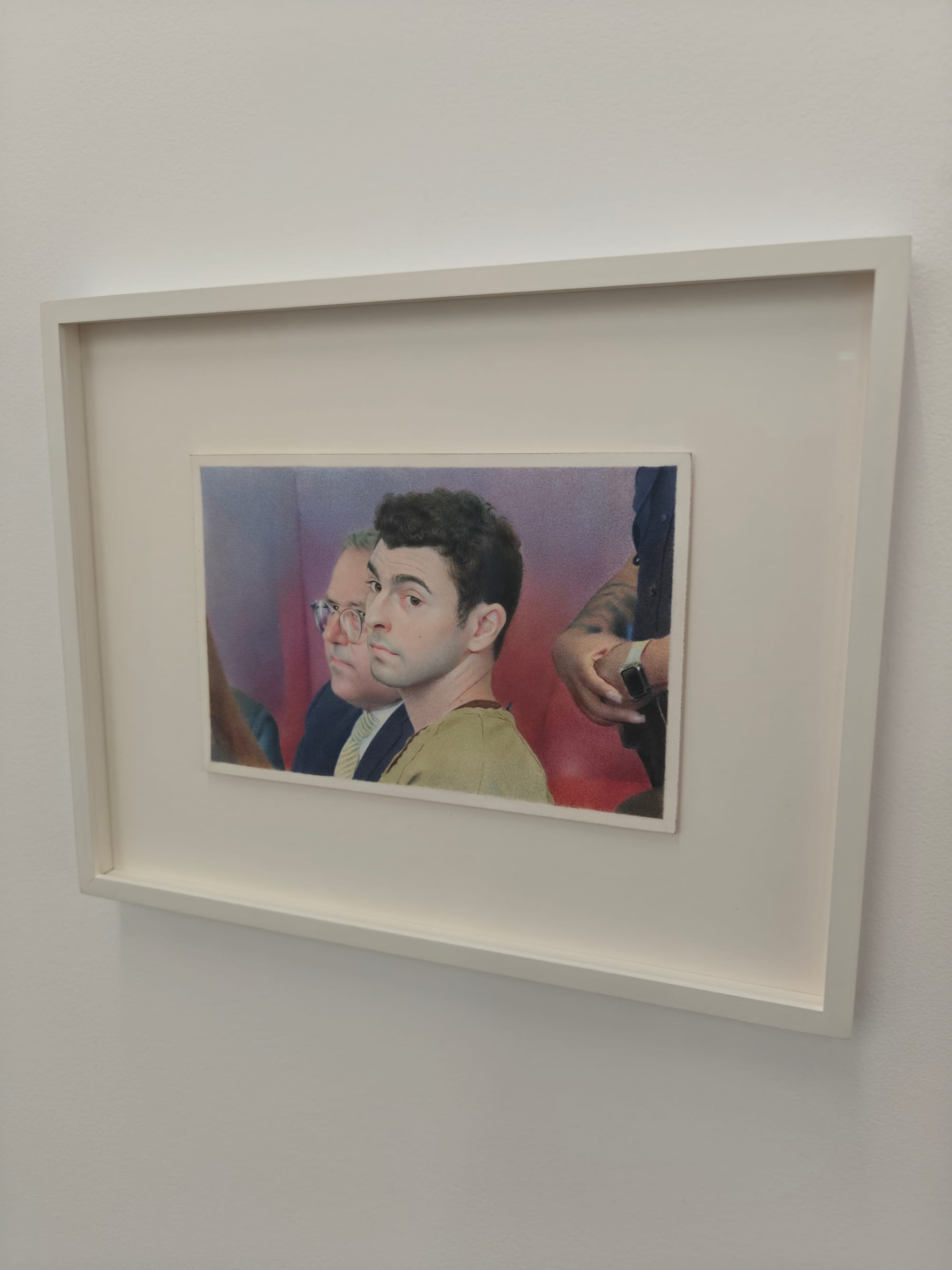
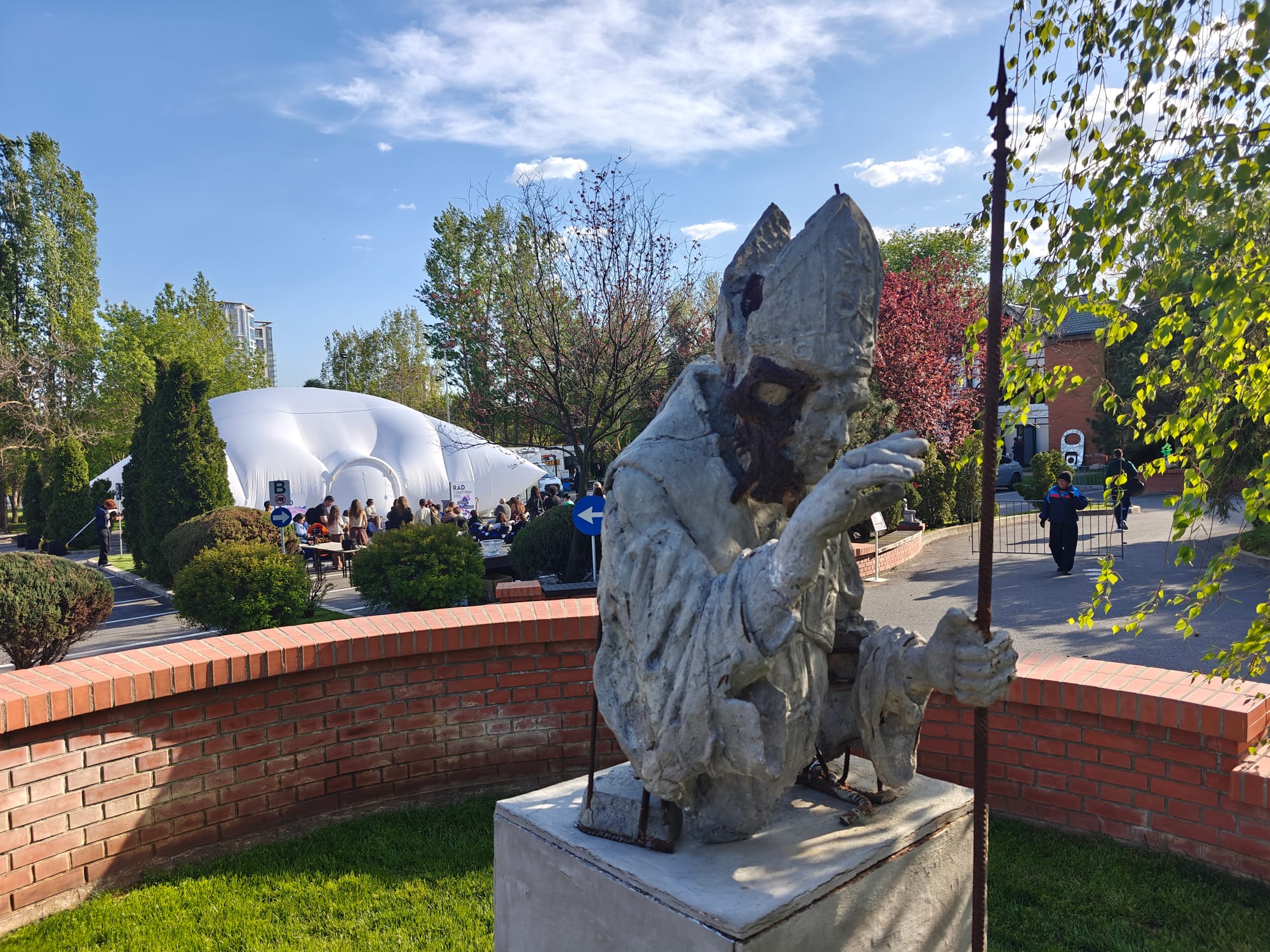
Left: Xavier Robles de Medina, “New York judge tosses terrorism charges against Luigi Mangione, lets murder count stand, Associated Press News, 16 September 2025” (2026) colour pencil on paper, 14x21 cm, - Catinca Tabacaru Gallery at Rad Art Fair - Right: Adrian Piorescu “Not Responsible For Anything” concrete and iron, 150 kg, 100x55x60 cm, 2025, Laborna Gallery - Installation view at RAD Sculpture Park, Panel at RAD Pavilion in background - Photo by Jak Ritger
RADical Art At the Fair
Only in its fourth year, RAD is a fascinating proposal. It’s a big-money art expo, but it leads with radical political art. Inside, I was greeted almost immediately with a coloured pencil drawing of the alleged UnitedHealthcare CEO shooter, titled New York judge tosses terrorism charges against Luigi Mangione, lets murder count stand, Associated Press News, 16 September 2025 (2026) by Surinamese artist Xavier Robles de Medina. This work is courtesy of powerhouse gallerist Catinca Tabacaru, who, along with Daniela Pǎlimariu, act as artistic directors of the fair. The most prominent through-line across the booths, showing the work of 30 participating galleries, was a sense of Romanian political discourse playing out across works that critique Communist kitsch, reference traditional folk revival, and represent ultra-contemporary material manipulation. As Tabacaru, who also works for a genocide tribunal and has a background in international law, told me, “My interests are civil rights, human rights, women’s rights—that's very natural for me. The program was always political, from the very beginning.”
In contrast to past moments of exoticism that characterized coverage of Romanian art, RAD feels unconcerned with an outsiderness (as seen from western eyes) and instead decidedly secure in its role as national scene-maker, or rather making a long vibrant scene legible to a global art audience and regional collector base. It’s Romanian galleries showing Romanian artists for Romanian collectors. If multipolarism is at play here, then it is being pulled into the gravity of this seductive tight-knit community. I realized I am going to have to dig into Romanian history and politics in order to catch the references and understand the radical statement happening in front of me.
The 2.5 floor exposition space at the Caro Hotel unfolds like a 3d maze with a sculpture park planted in the surrounding outdoor space with works woven into walkways, grassy patches, brick walls and every nock and cranny. The sculpture park serves as a contextual invitation, “people are already thinking about what they can make for next year.” Tabacaru tells me. The central atrium of the main space is occupied by a large installation work by Victoria Zidaru. Tubular tapestry pieces form a canopy beneath the skylight and snake down like papery icicles. The work has a certain organicism to it, feeling more grown than fabricated. Speaking with the co-directors of SUPRAINFINIT that mounted the installation, Suzana Vasilescu and Cristina Vasilescu (no relation), I discover that this piece is making a rather bold political statement about the current moment of Romanian art.
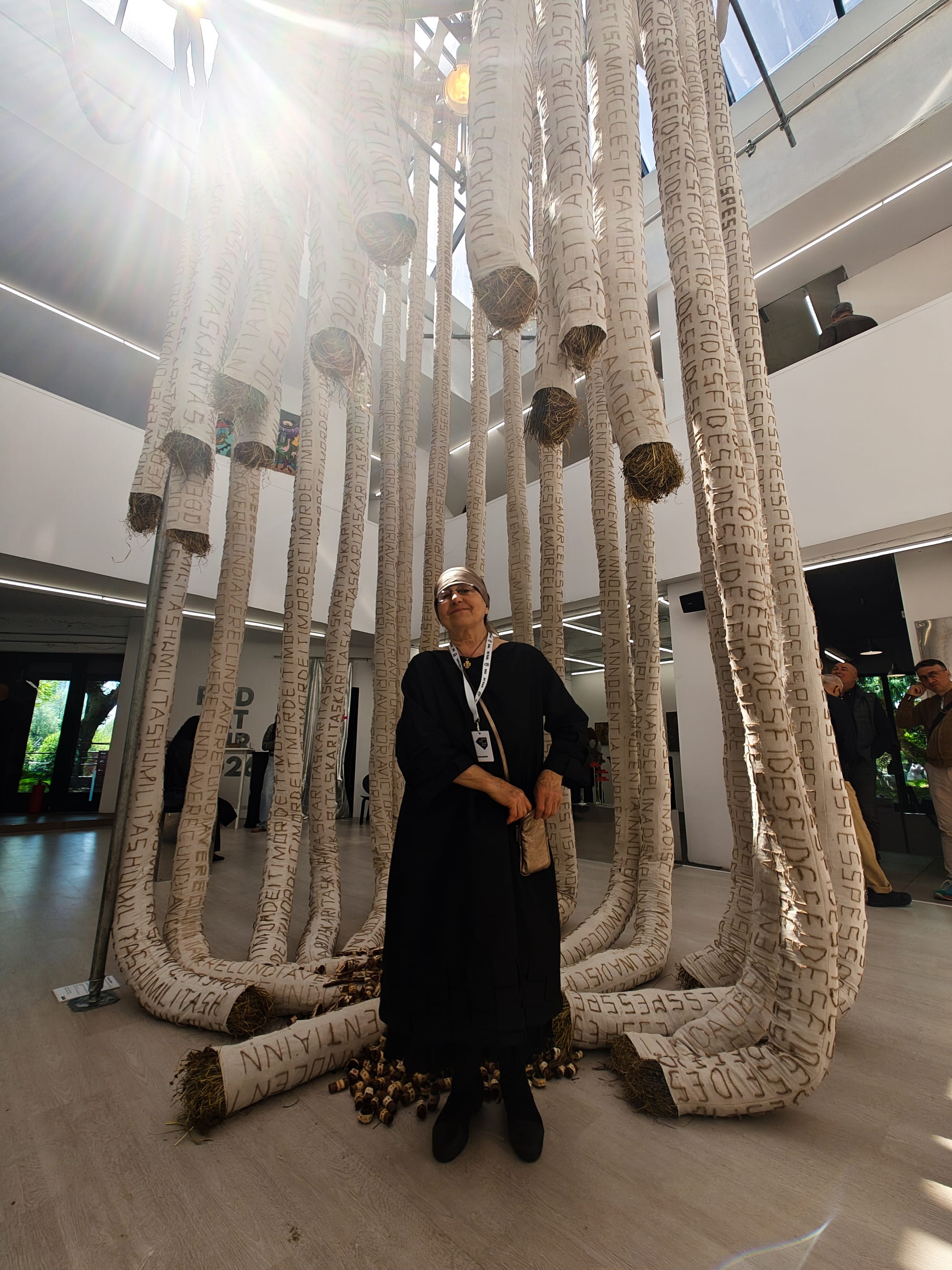
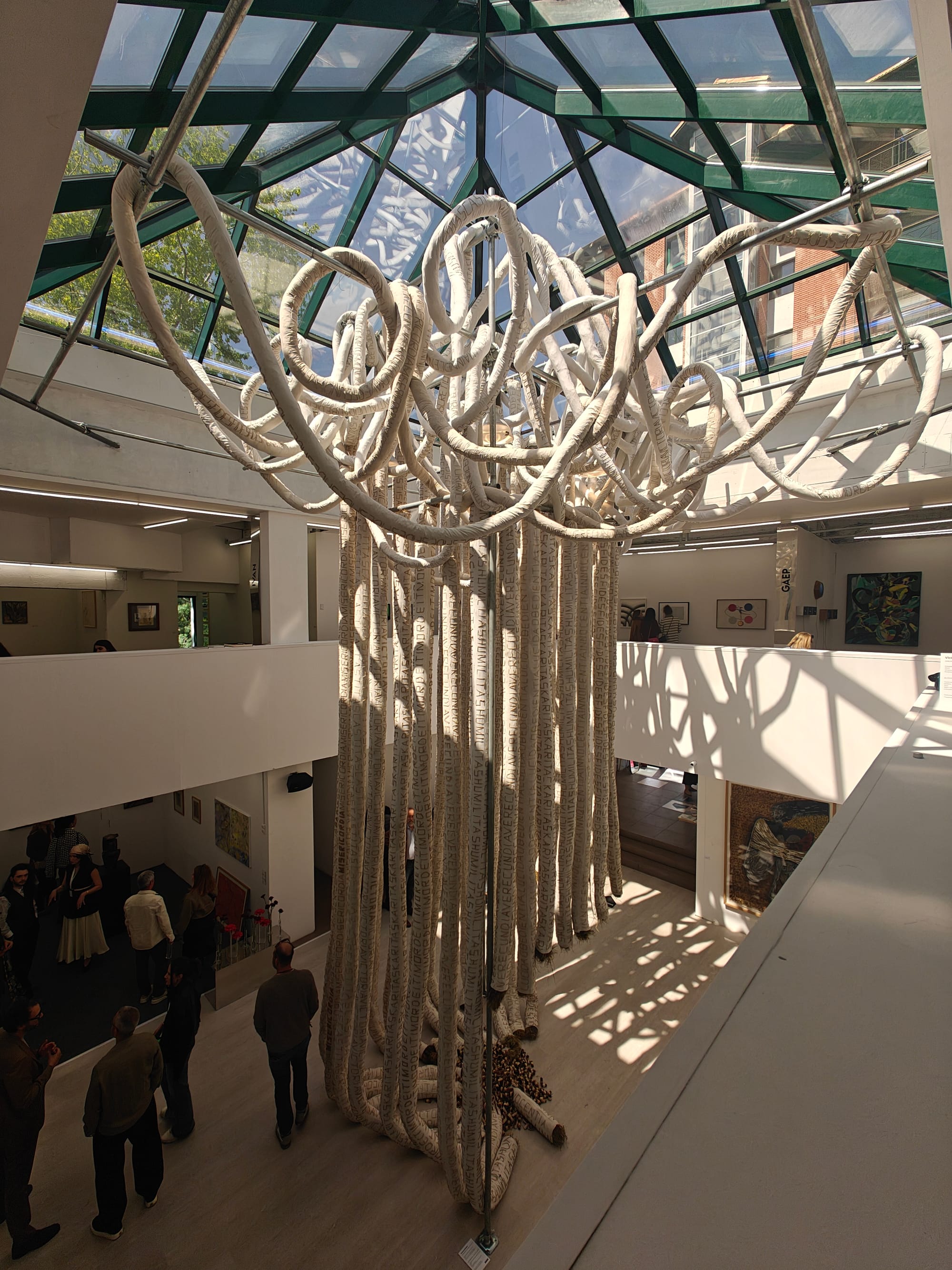
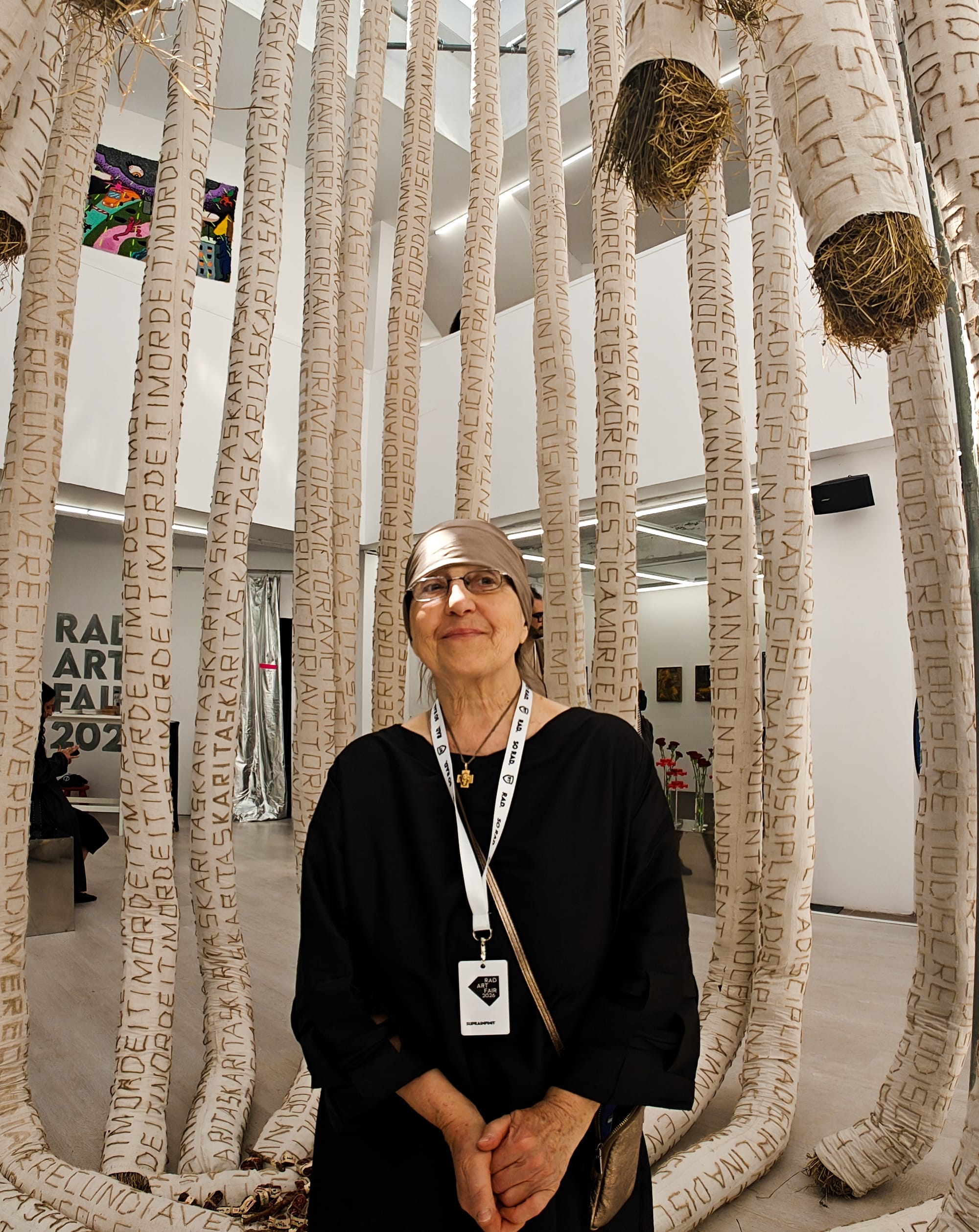
Artist Victoria Zidaru with “Blossoming Free - The Tree of Virtues” textile installation incorporating vegetal and olfactory elements. 9000x500x400 cm, (2025) Embroidery, handmade canvas, vegetal material - Presented by Suprainfinit Gallery, RAD Art Fair - photos by Jak Ritger
Zidaru and her partner, artist Marian Zidaru, were part of a natural avant-garde that formed after the fall of Nicolae Ceauşescu, the Communist who led Romania as president from 1974 until his execution in 1989. During this period, the economy liberalized, and a network of art centers sprang up across Eastern Europe, funded by Hungarian-American billionaire investor, philanthropist, and activist George Soros’s Open Society Foundation. While the Soros Center for Contemporary Art (SCCA) was founded with the supposed mission of promoting free expression and instilling democratic values across formerly Communist countries, their curatorial filter selected for artists that fit into the established norms of Western art-making aesthetics. Those like the Zidarus, who drew from older traditions or who engaged in different visual systems, were ignored by the art centres that were seeded in the 1990s and 2000s.
Yet during this time, the Zidarus developed an immense body of work and a thriving workshop community after leaving a religious cult named New Jerusalem in Pucioasa. When walking by their studio during a tour of Combinat a man emerged from the door, when asked about his role in the studio he responded “I am a disciple.” By placing Victoria Zidaru’s installation as the centerpiece of the fair, RAD is righting a wrong, re-introducing a masterwork and making a statement for a new era of Romanian art: yes, we are open for business, but it is we—not those who are merely trying to emulate the codified art systems of the West—who are selecting what represents top-level contemporary Romanian art.
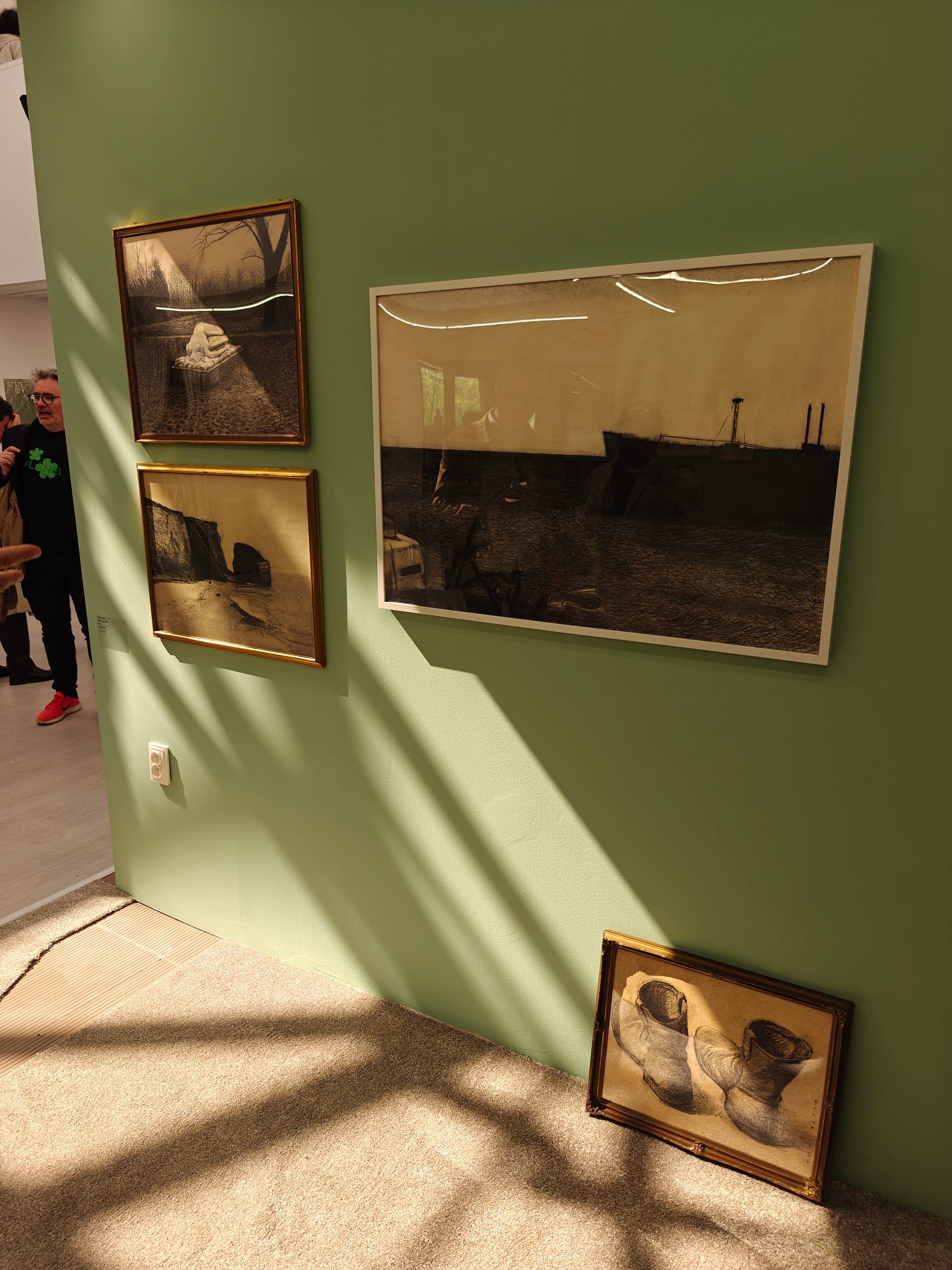
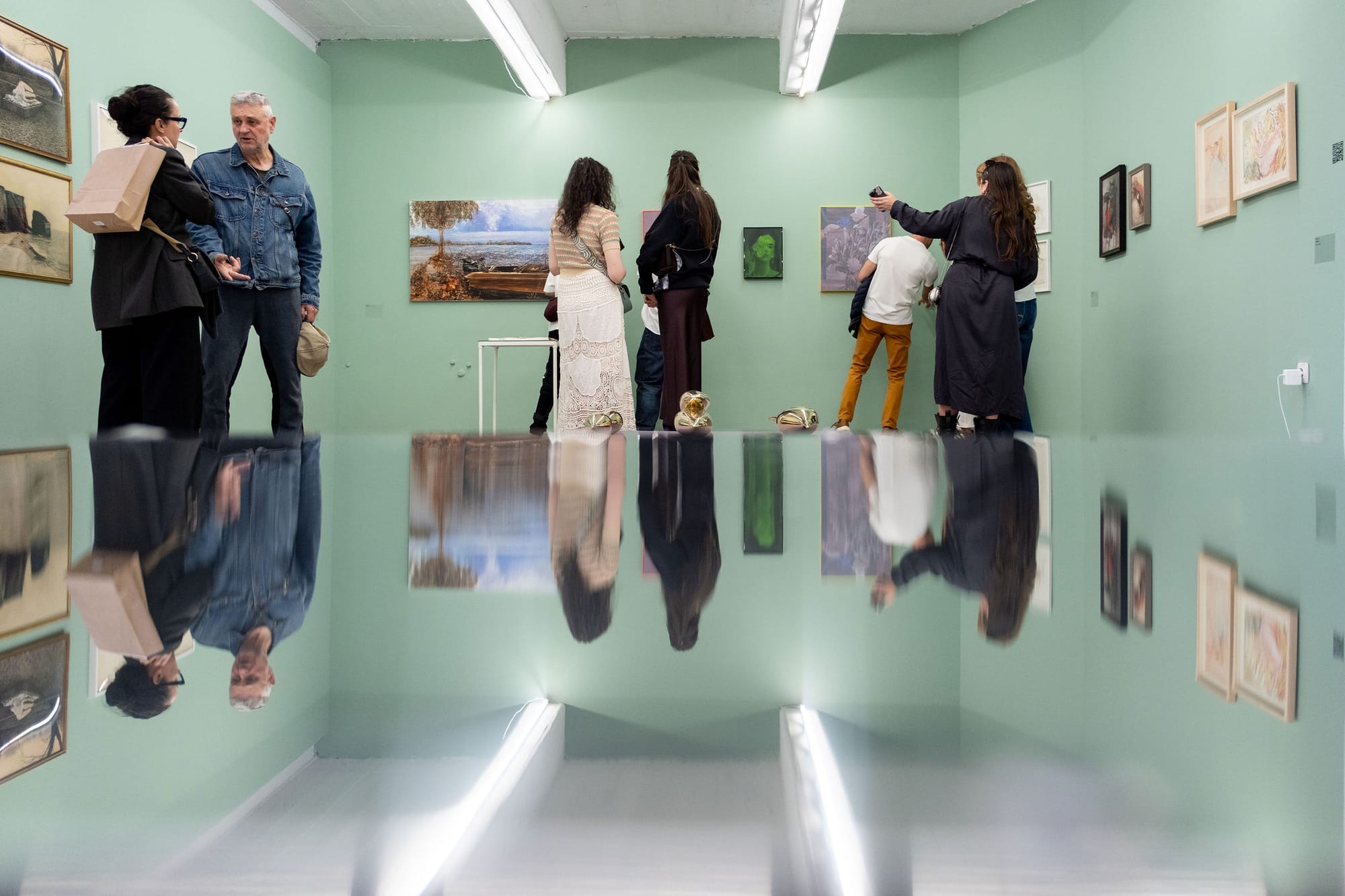
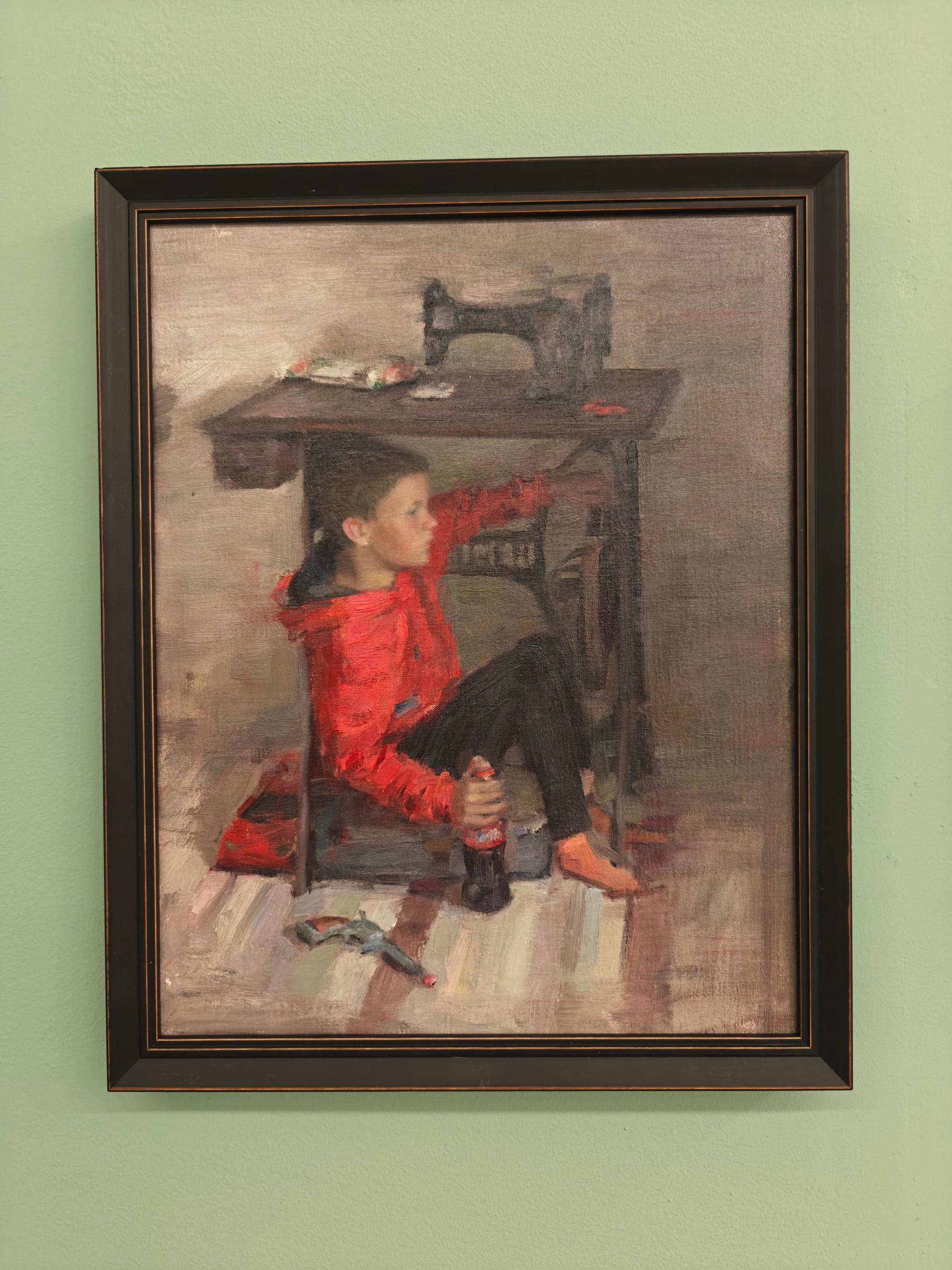
Left: Teodor Graur, “Parcul cu statuie” graphite and gouache on paper, 26x60 cm, 2026 - “Falezǎ la Marea Neagrǎ” graphite on paper, 40x60, 2026 - “Navǎ” graphite and gouache on paper, 69x99 cm, 2026 - “Bocanci militari” graphite on paper, 40x50 cm, 2026 - Center: Sandwich Gallery booth, photo by YAP studio, courtesy RAD Art Fair. Right: Lucian Prunǎ, “Copilul” oil on canvas 50x40 cm, (2026) L/R photo by Jak Ritger
The first gallery I wander into is Sandwich Gallery with cozy carpet and pastel green walls. I learn the theme is nostalgia as co-founder, Alexandra Niculescu describes how his mother would mix the bright green paint meant for farm equipment with white in order to decorate the house. The booth features haunting graphite and gauche landscapes marked with military aftermath by Teodor Graur, one of the godfathers of Romanian contemporary art. On the opposing wall are two paintings by Lucian Prunǎ who is playfully described to me by friend as "Romania’s Thomas Kincaid" for his wild popularity and willingness to sell commissions to huge corporations like Coca-Cola. The selections here are quiet domestic scenes with quiet quotidian softness, not the consumer product spreads he is known for. Coming to Eastern Europe for the first time, I am struck by the presence of American corporate logos throughout signage. I learn that during the period of transition to capitalism the giant Coke logos represented the countries rapid embrace of western consumerism.
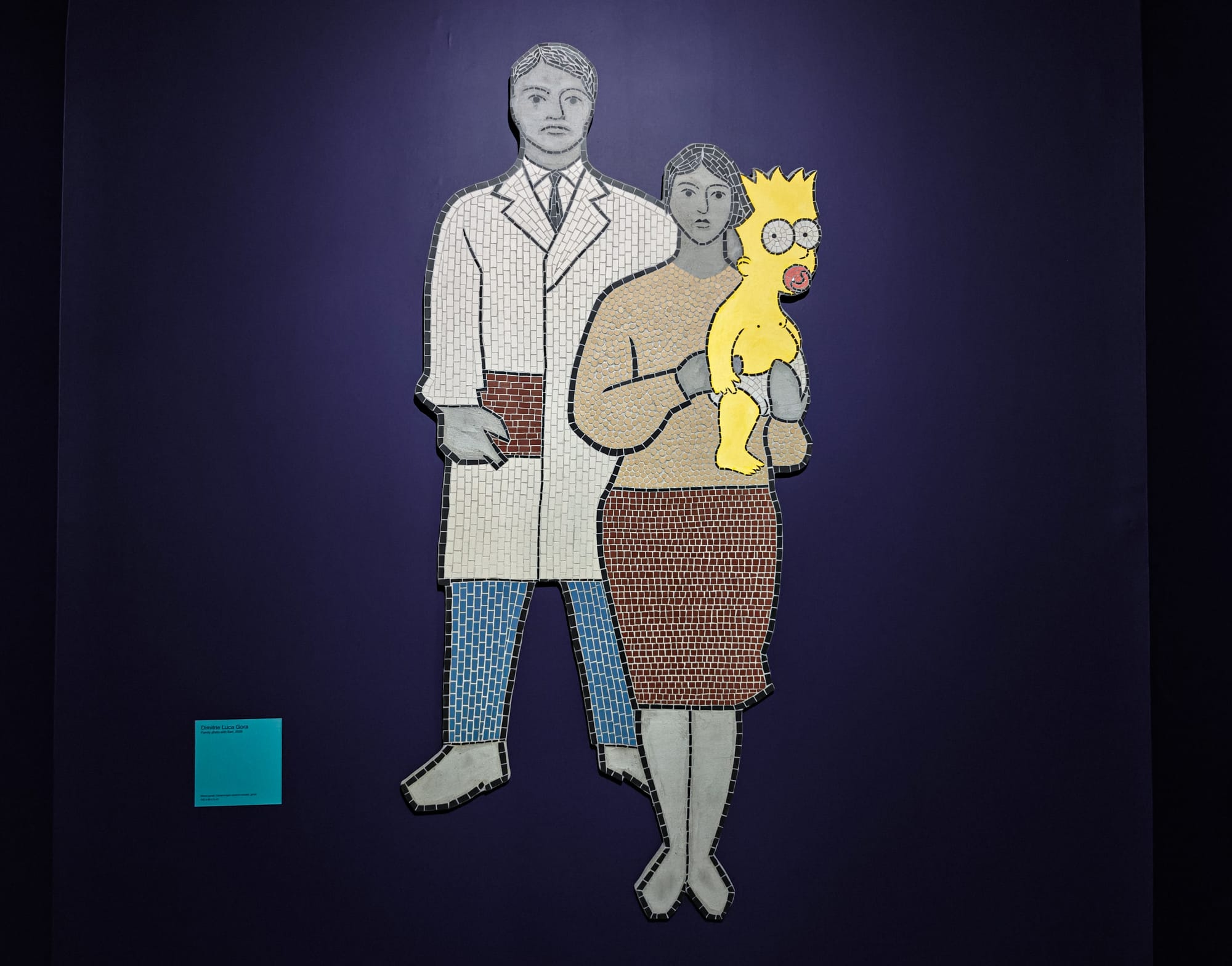
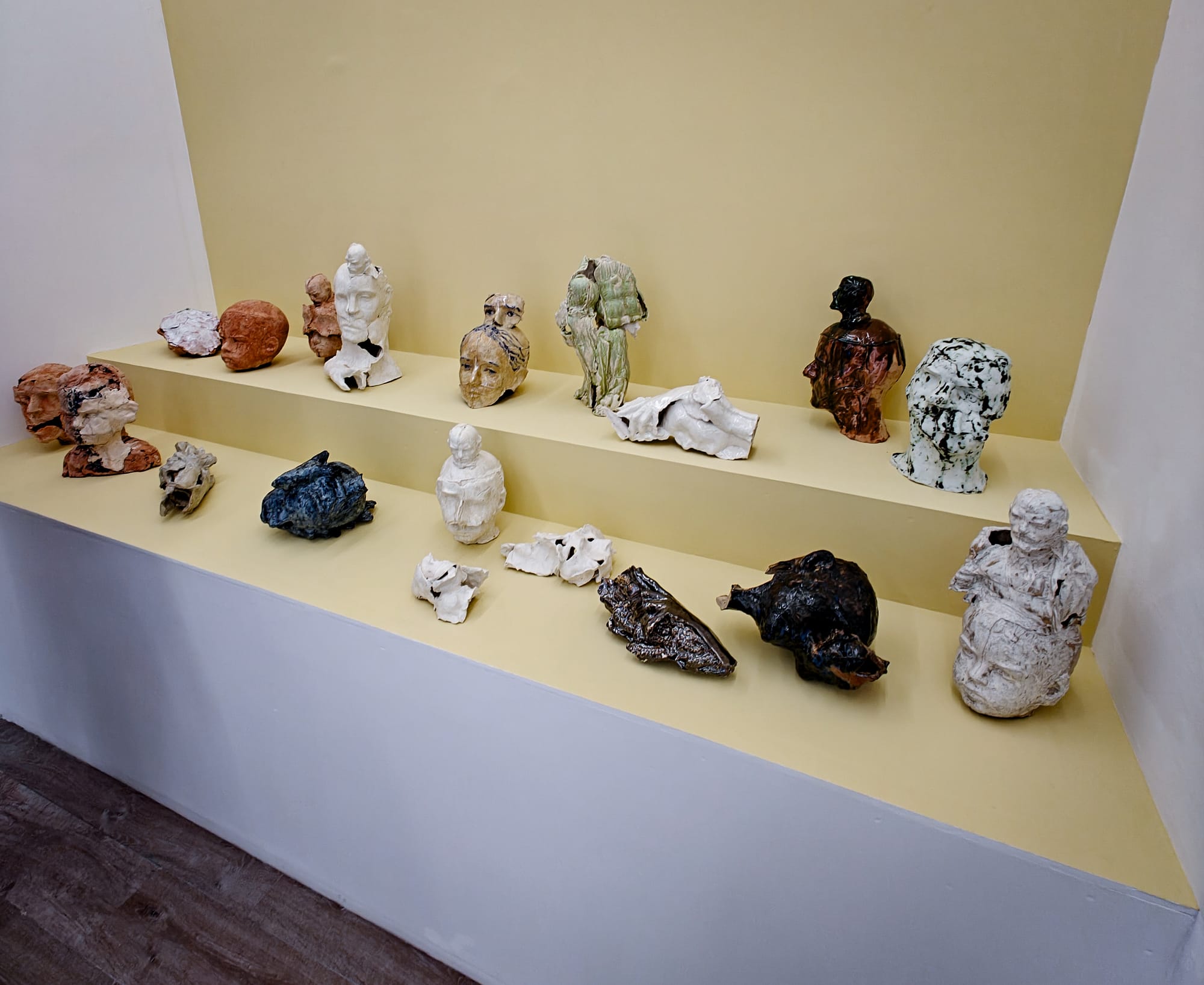
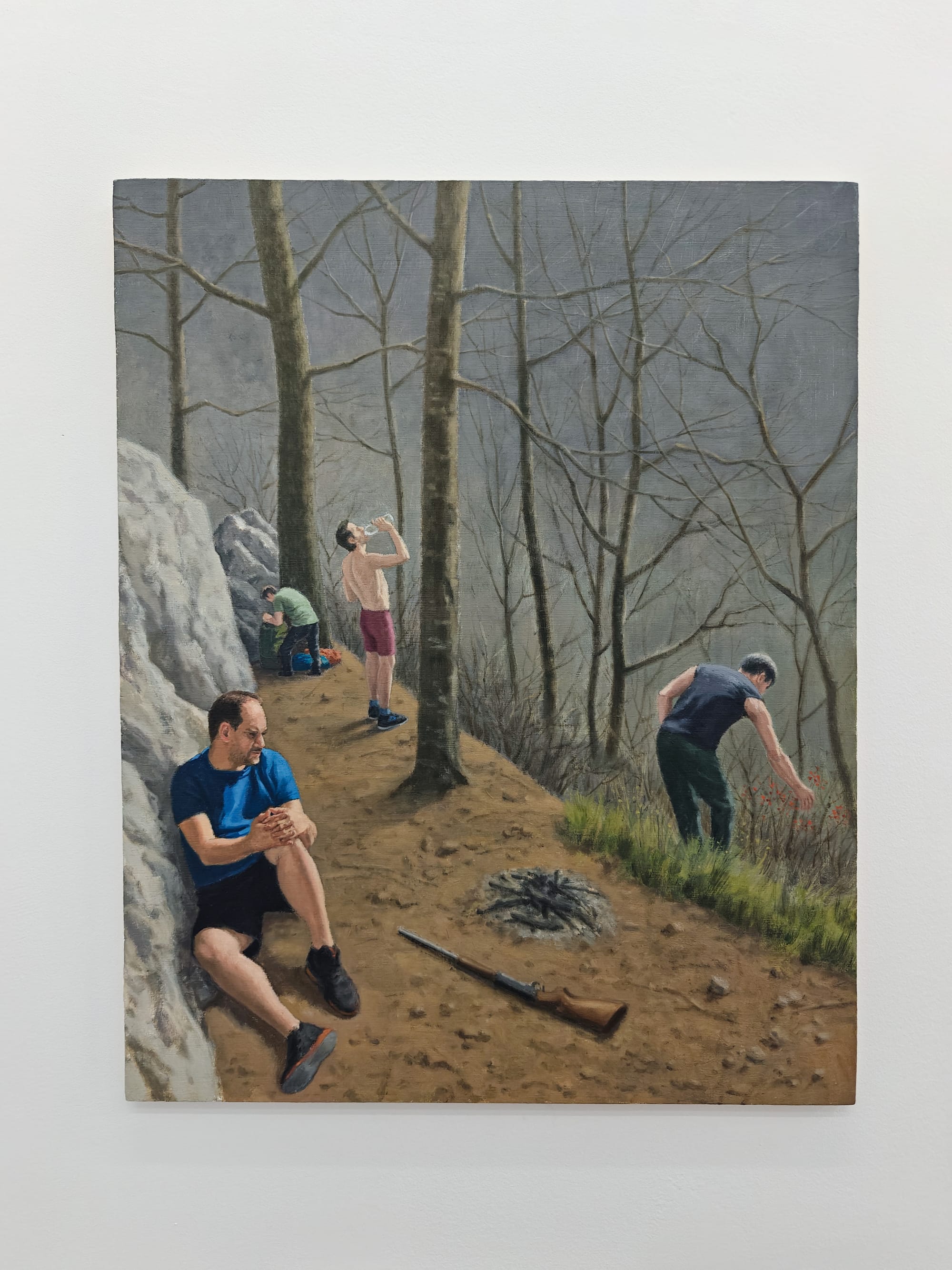
Left: Dimitrie Luca Gora “Family Photo with Bart” wood panel, ceraton-type ceramic mosaic, grout 160x80x3 cm, (2026) - /SAC Gallery - Center: Ciprian Mureșan, “Untitled”, glazed ceramic, 2025-26 - Plan B Gallery - Right: Serban Savu, “Hunting Scene” oil on panel, 70x56 cm (2024) - Plan B Gallery at RAD Art Fair - Photos by Jak Ritger
The aesthetics of socialist realism are used as raw material throughout. Dimitrie Luca Gora’s Family Photo with Bart at /SAC infiltrates a traditional ceramic mosaic family scene with American pop-culture. The strikingly eerie and expertly crafted piece comments on the power of western capitalist symbols to overwhelm the fragile post-communist visual landscape. At Plan B, Ciprian Mureşan remixes his own canonical work that is in turn sculpted from memory of patriotic busts from the Ceaușescu years. The twisting, fractured forms speak to the patina that has covered over difficult cultural traumas, a semi-somnambulant state of half-remembering. Across the booth, a party of hunters take a break on a hillside in Serban Savu’s picture of leisure, procrastination and boredom in the style of Eastern Bloc propaganda. The picture calls on a sense of historical uncertainty and political purgatory following the fall of communism. But I also see the importance of community and collaboration in the wake of these political struggles. Featured in “Hunting Scene”is Savu’s close friend and collaborator Mureşan sitting against the hill side. The two worked together for the Romanian pavilion at La Benielle 2024, Mureşan curating Savu’s exhibition.
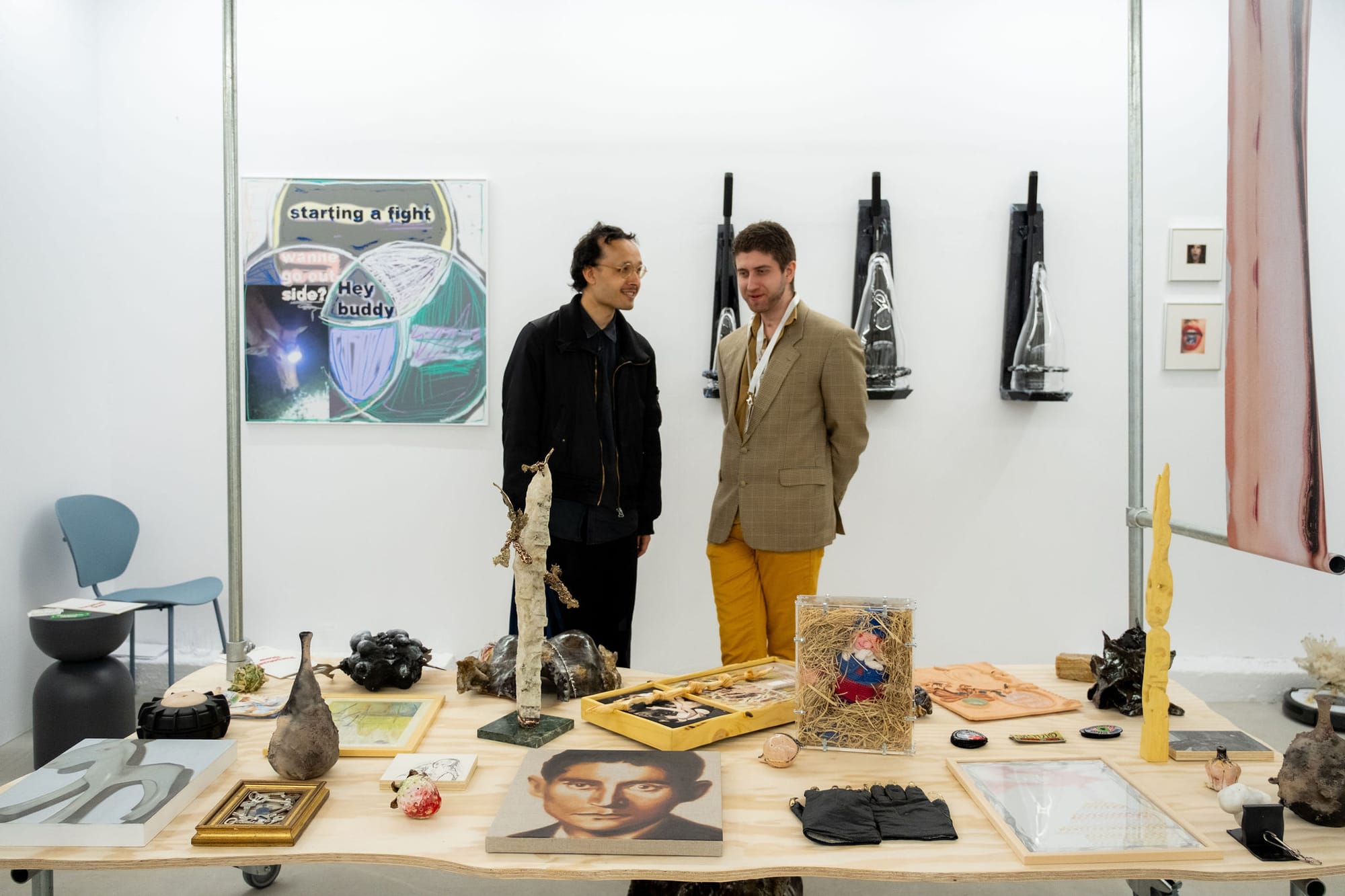
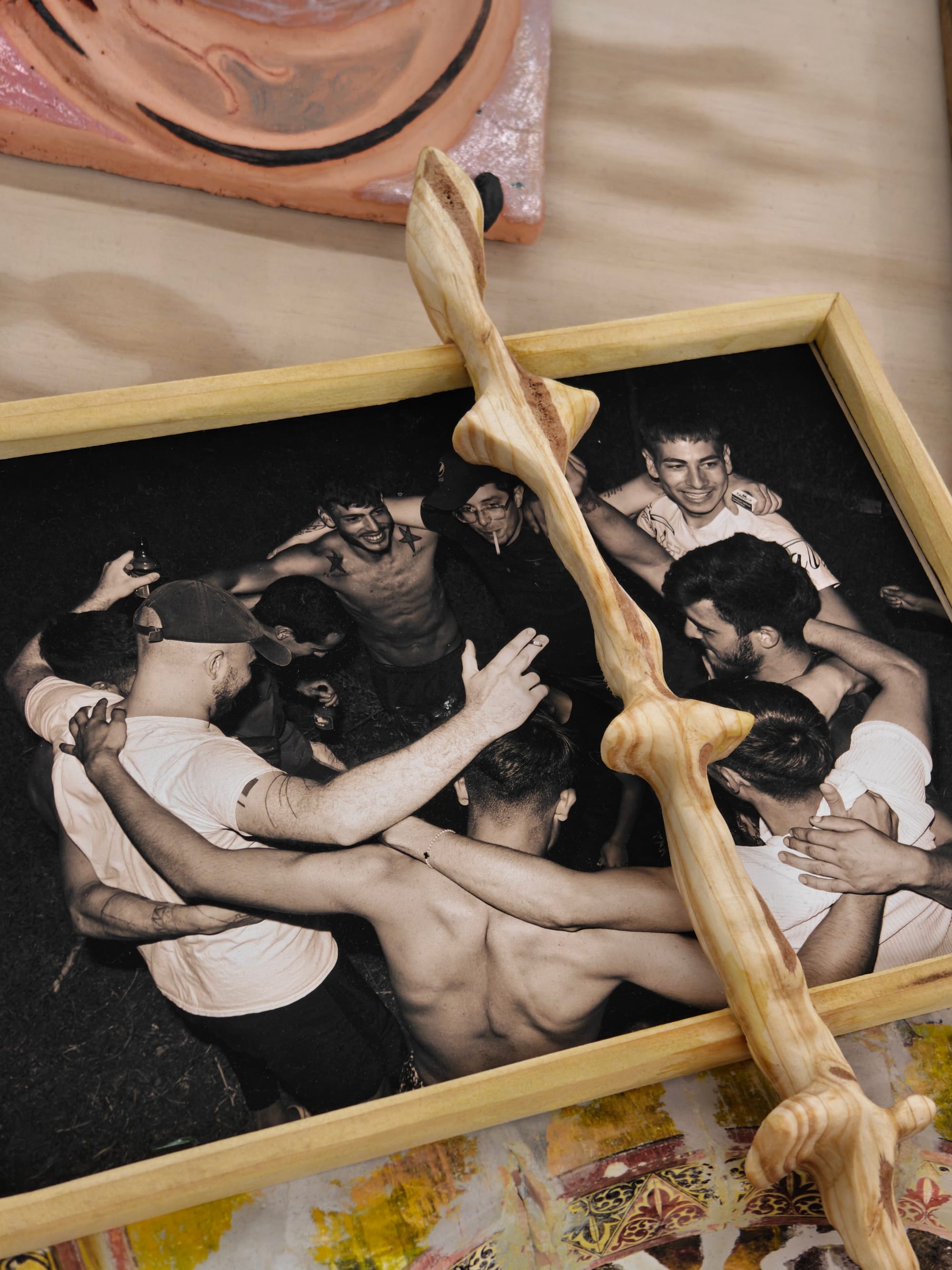
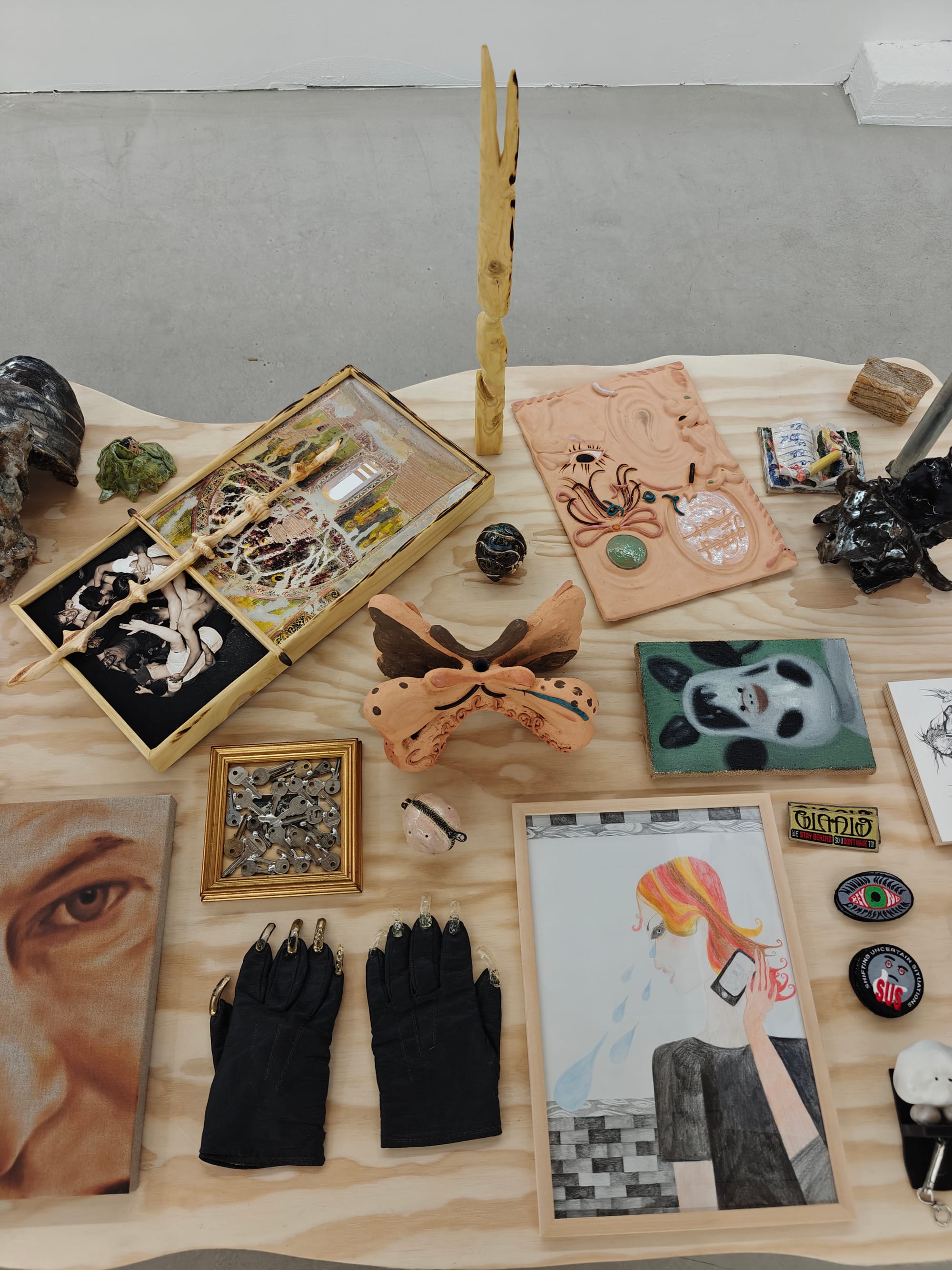
Left: Artist Azadbek Bekchanov visits Pharmakon Gallery booth and chats with Gallerist David Cian about “Perpetual Stew” Daniel Van Straalen (wall works) and STOL Collective (table installation), April 23, photo by YAP studio, courtesy RAD Art Fair - Center: Marco Verhoogt “Plăsoiu Invocation” (2026) archival inkjet print, Fir wood, pigments, tung oil, 70x30 cm. [ Easter Egg: Pharmakon Gallery director, Christian Roncea can be seen in the center wearing black hat and smoking a cig ] - Left: “Perpetual Stew” by STOL Collective, photo by Jak Ritger
The tight-knit artist community in Bucharest takes center stage at the Pharmakon showing of STOL Collective through a rotating daily program titled “Perpetual Stew.” Ceramic ocarina’s wrapped with wired headphones and crabs mix in with a photograph of a party circle embrace in an wooden artist frame, subtle paintings of friends and personal iconography. The earthy tones of the collection feels like a memory box from the formative years of your life. Surrounding the wavy edged table installation are wall works and readymades by Dutch conceptual artist, Daniel van Straalen. His work circulates the vibe frequency of memes while smoothing and splitting images for a decidedly open and uncanny interpretation. A stack of pizza boxes gives a Mona Lisa smile as you try to decipher a message from the code of thumbholes while an ominous countdown clock is flanked by AI-generated Olsen twins. The ultra-contemporary showings continue at the Non-Space installation which transforms the art fair booth into a platform for performances against a backdrop of digital photo blow-ups with surveillance camera grain.
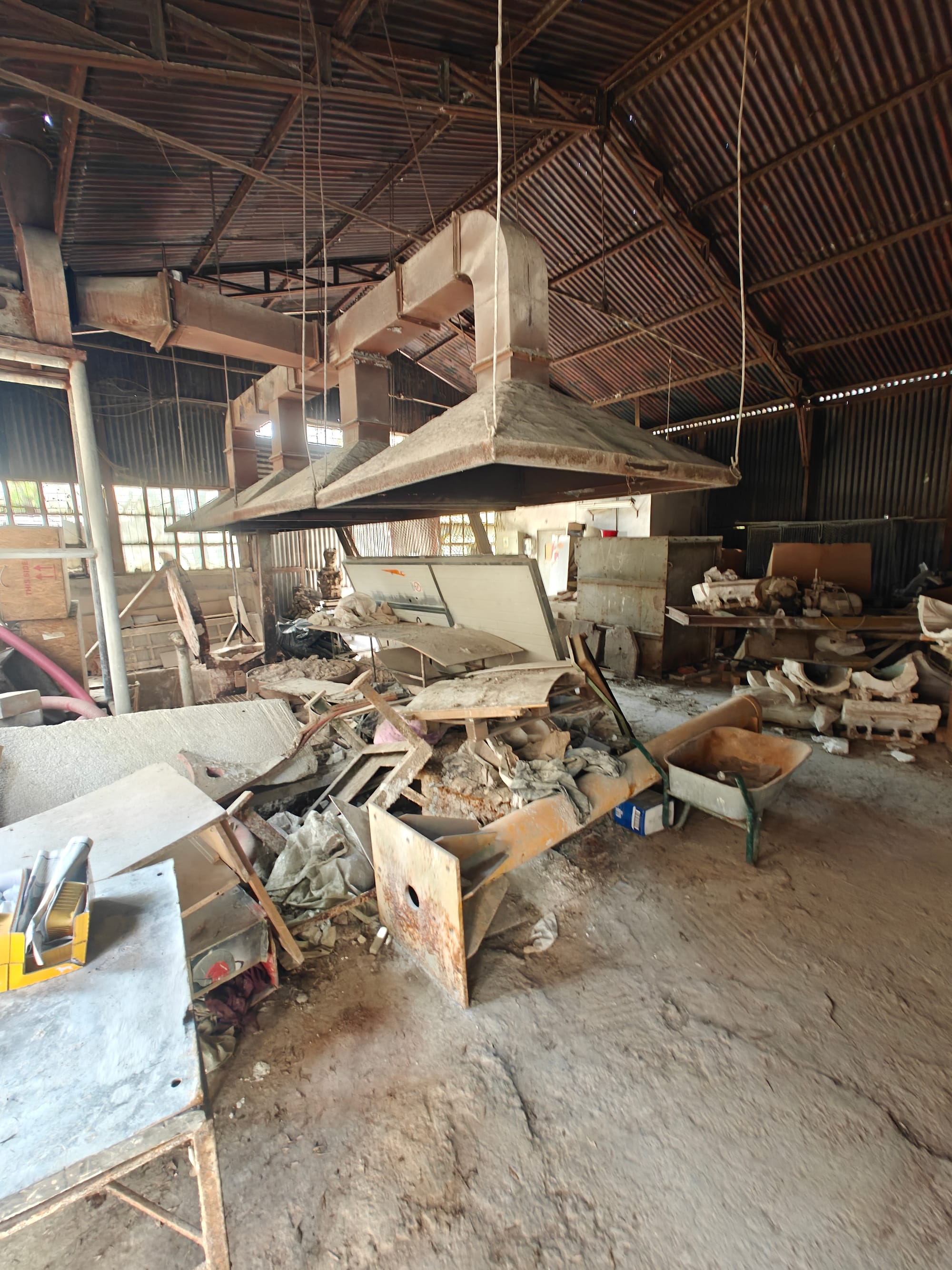
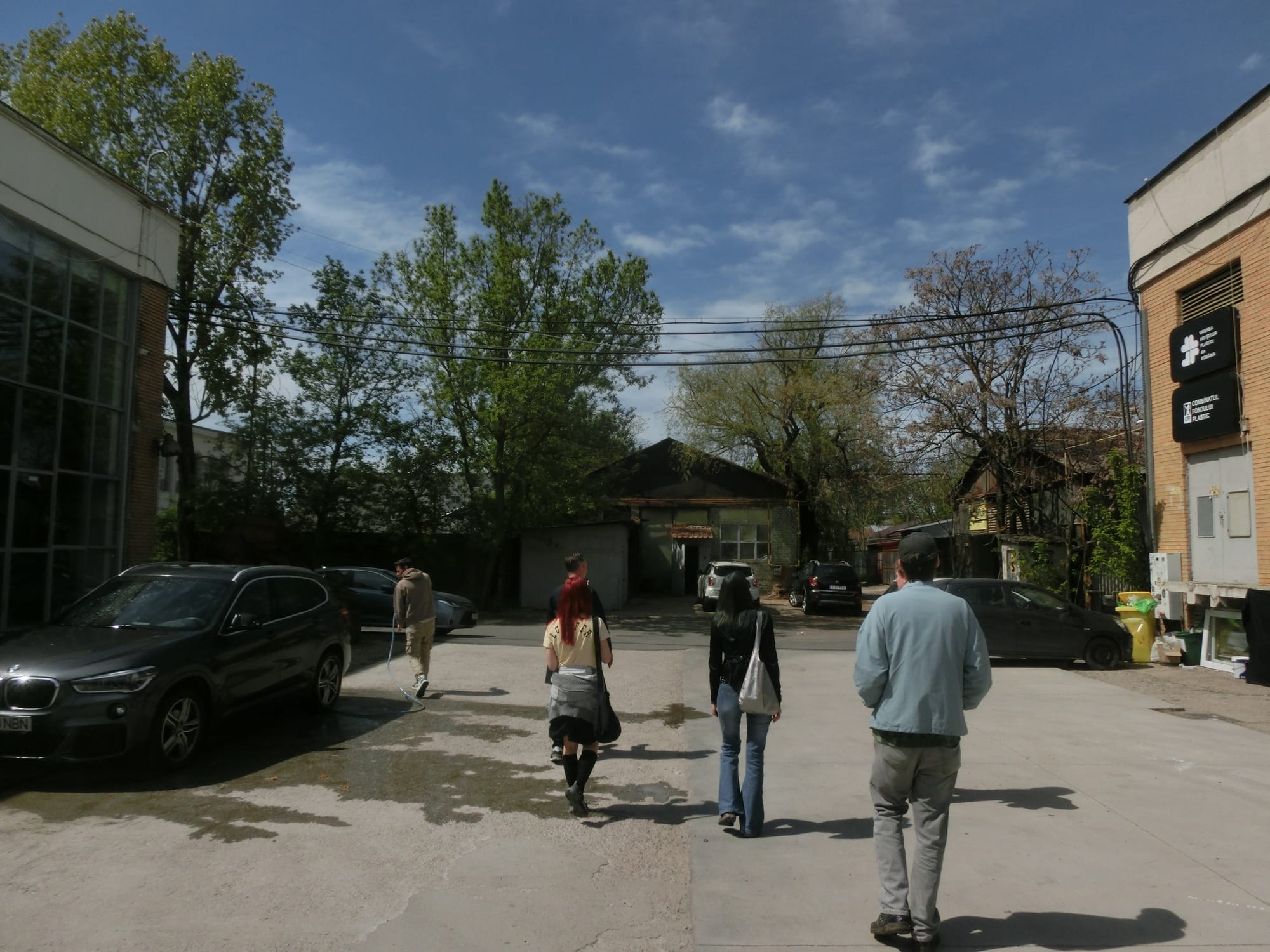
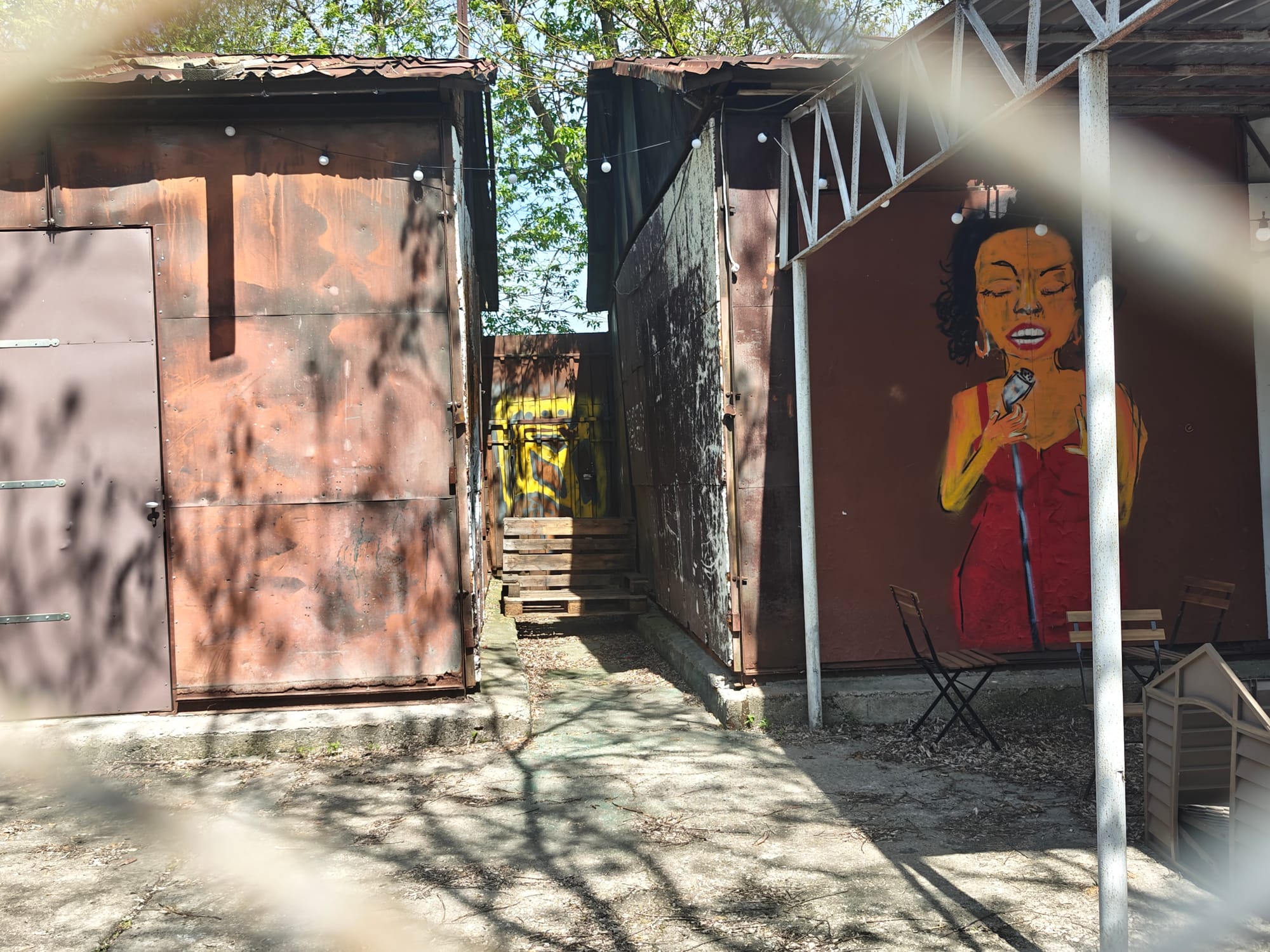
Combinatul Fondului Plastic - Left: remnants of a sculpture workshop - Center: exploring - Right: the original space of Sandwich Gallery was sandwiched between two workshop buildings.
Boots on the Ground in Bucharest
RAD Fair acted as a tractor beam to pull in artists, collectors and 25 curators as part of a visiting curator program to the city. The goal was to demonstrate Bucharest’s potential as an international art destination. Venturing out from the art fair illustrated how the work on view has been influenced by the city’s psychogeography. During my stay, curator and experimental anthropologist Aaron Moulton took me and a crew of internet artists—Sara Bezovšek, Tibor Dieters, Al Hassan Elwan (½ of @POSTPOSTPOST), Günseli Yalcinkaya, and others—on a tour of cultural sites. We visited Combinat, a group of buildings that once housed workshops for the production of patriotic sculptures and monuments under Ceauşescu. Now the vaulted industrial shops serve as a spacious exhibition space for SUPRAINFINIT, Nicodim, Sector 1 and Sandwich galleries, alongside artist studios. We stopped by Ceauşescu’s former palace, an 80-room villa that’s the second largest building in the world, and is now home to Muzeul Național de Artă Contemporană and other cultural offerings.
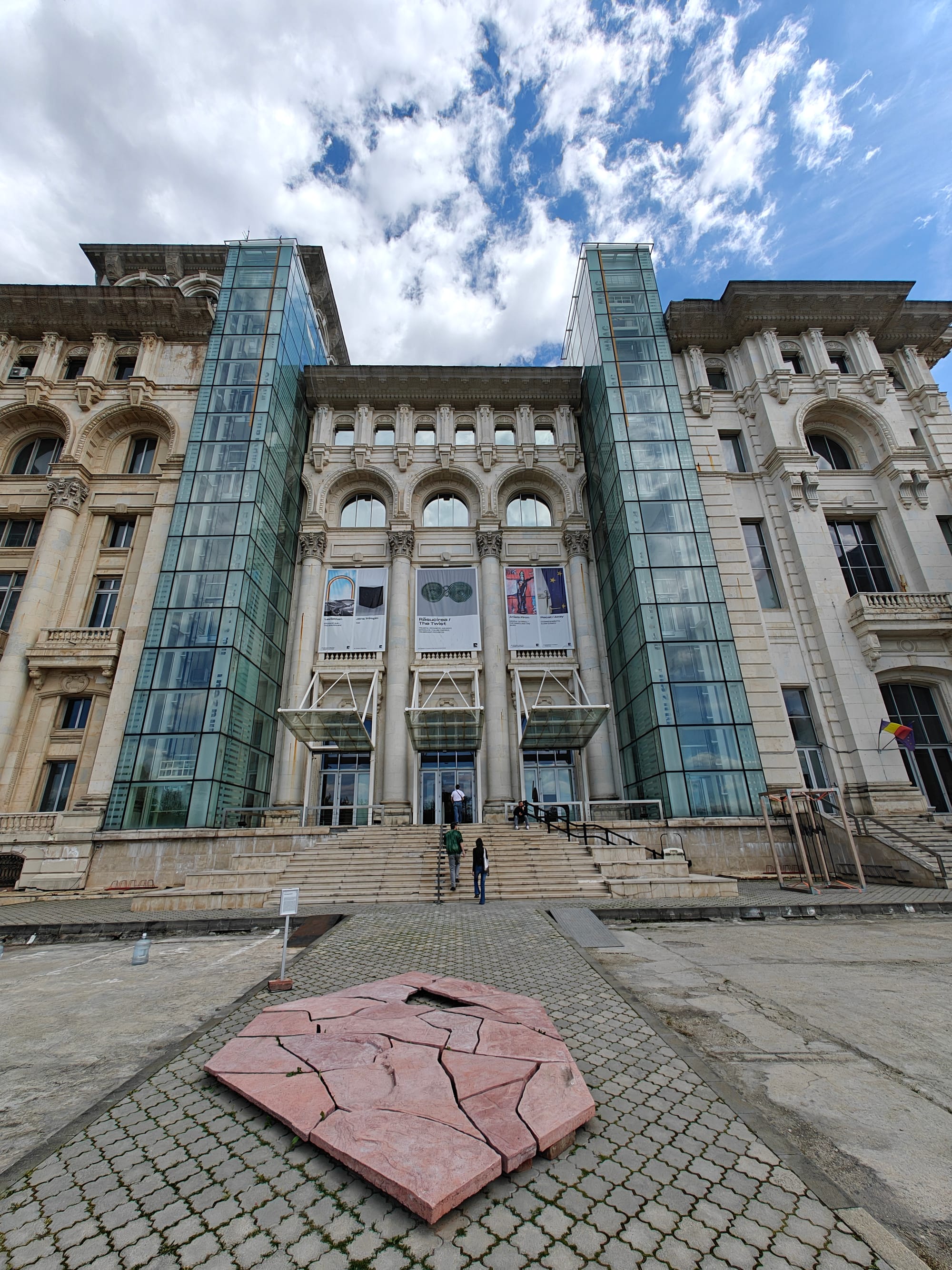
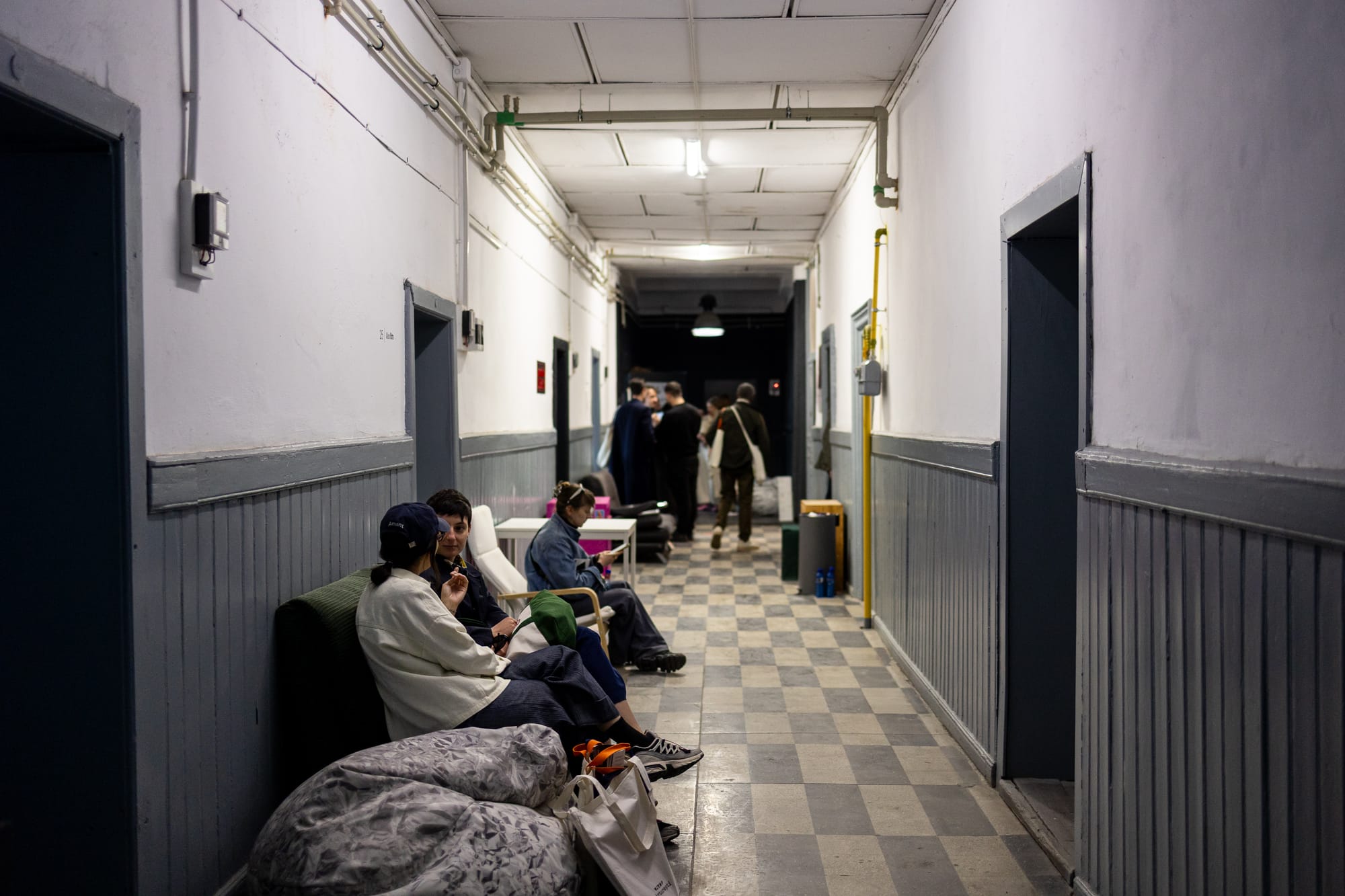
Left: exterior of Muzeul Național de Artă Contemporană, photo by Jak Ritger - Right: RAD Event at Atelierele Malmaison, April 22, 2026, photo by Rares Toma, courtesy of RAD Art Fair
And then there is Atelierele Malmaison on Calea Plevne—an arts collider and studio space hub carved out of the former prison for the bourgeoisie. Walking the hallway, I notice that one of the heavy metal prison doors remains in use. It's no wonder that Romanian artists are so steeped in the politics of memory, as the buildings where art is created and shown carry these traces. It clicks that ethos of state mandated art-as-propaganda during communism and then the paranoia of outside influence in art afterwards has produced a widespread sensibility that all art is political one way or another. Even apolitical work is taking a position within economic structures. Political art and a political reading of art is the de facto mode here, not the outlier that I am used to.
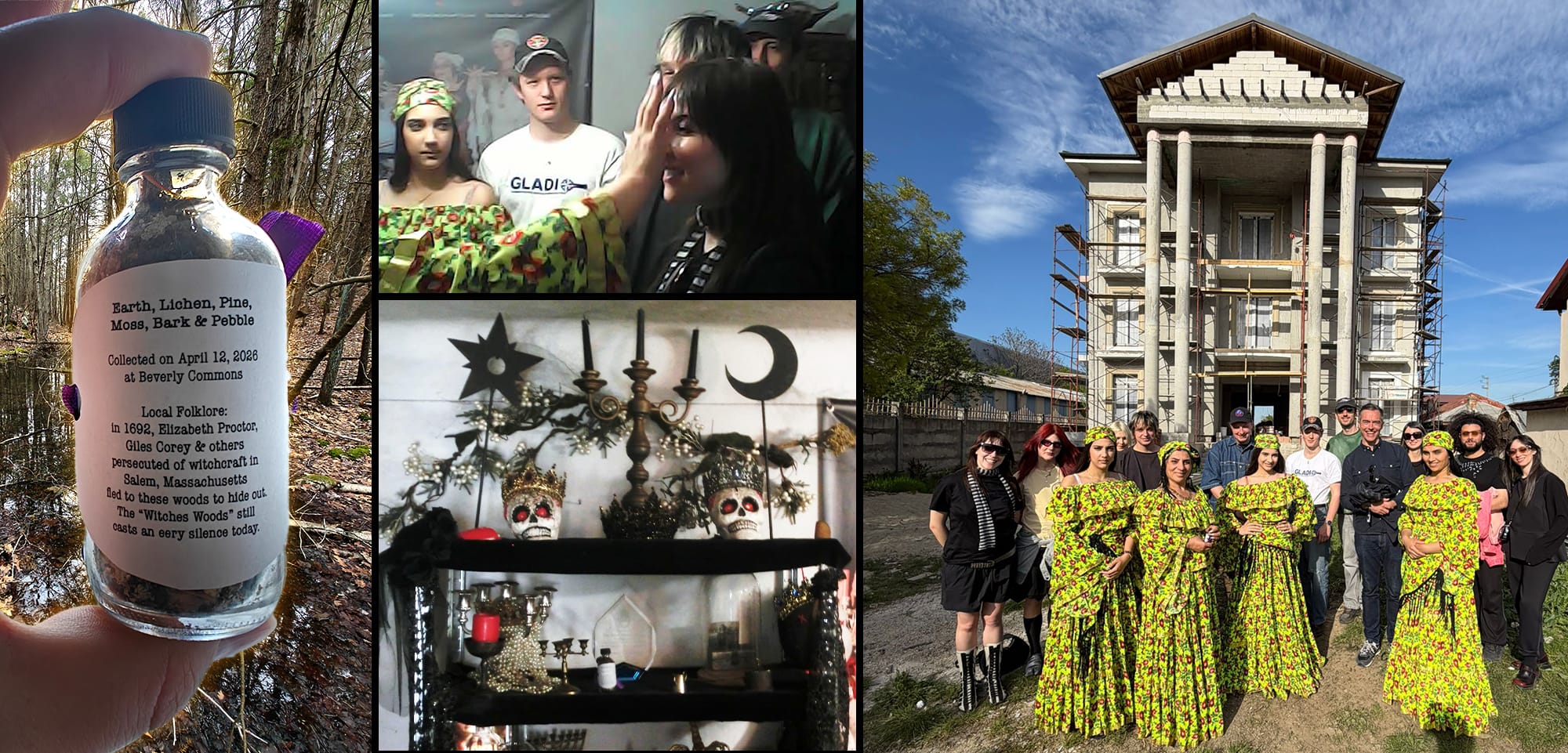
The last stop of the tour of Aaron's favorite spots of Bucharest was at the home of Mihaela Minca and her family / coven of witches that practices traditional Roma witchcraft. We sat around a big patio table and discussed the difficulties Roma faced historical, what it takes to cast spells, cursing politicians and the soon to open "Mihaela Minca Roma Cultural Institute"—a museum for Roma heritage preservation and school for witchcraft. Aaron encouraged the tour group to bring gifts and so I prepared something special: a glass jar with collected soil, lichen, pine, moss, bark and pebble from the "Witches Woods" in Beverly, Massachusetts. Legend has it that the Salem Witches fled persecution and hit out in these woods, it still holds a spooky charge today. Mihaela is moved by this offering and places the jar on an altar of spiritually activated objects. My favorite part of the visit was the wardrobe room of traditional Roma long dresses that are custom made for the coven from elaborate vibrant patterned fabrics. The visit concludes with a blessing of good luck from coven. I think it really worked because the following day we filmed "Spooky Castle II" and it went off without a hitch, but that's a story for another day.
Later that night, I attended an afterparty at the home of Cristina Vasilescu and Christian Jankowski in a gorgeous 19th-century apartment. We sat around a squiggly-shaped table, an artwork titled Rostralia (2024) by Jankowski that mashes up the maps of Romania and Australia, forming a new shape that draws attention to the strangeness and unpredictability of cultural exchange. While we waited for the rest of the party to arrive, Vasilescu read aloud from a recently unearthed decades-old newspaper clipping she about the history of the house. We listen, mouths agape, to the intense drama it reported between neighbors. Even domestic spaces are alive with history.
From New York with Love
The lower price of running a gallery in Romania allows for more complex programming, as it became clear when I spoke to Catinca Tabacaru about her eponymous gallery. Tabacaru ran a New York City gallery for 12 years before moving the operation to Romania during Covid-19. “When your rent is lower, you can put more time into shows. We are now able to work for almost two years on a show.” The exhibition on view, Have No Doubt of the Omnipotence of a Free People, is curated by Raphael Guilbert and tells the little-known story of Romania’s involvement in the dissolution of apartheid Rhodesia and the establishment of Zimbabwe. The show brings together artists from both countries with historical and contemporary works addressing freedom, identity, censorship and industrial modernization.
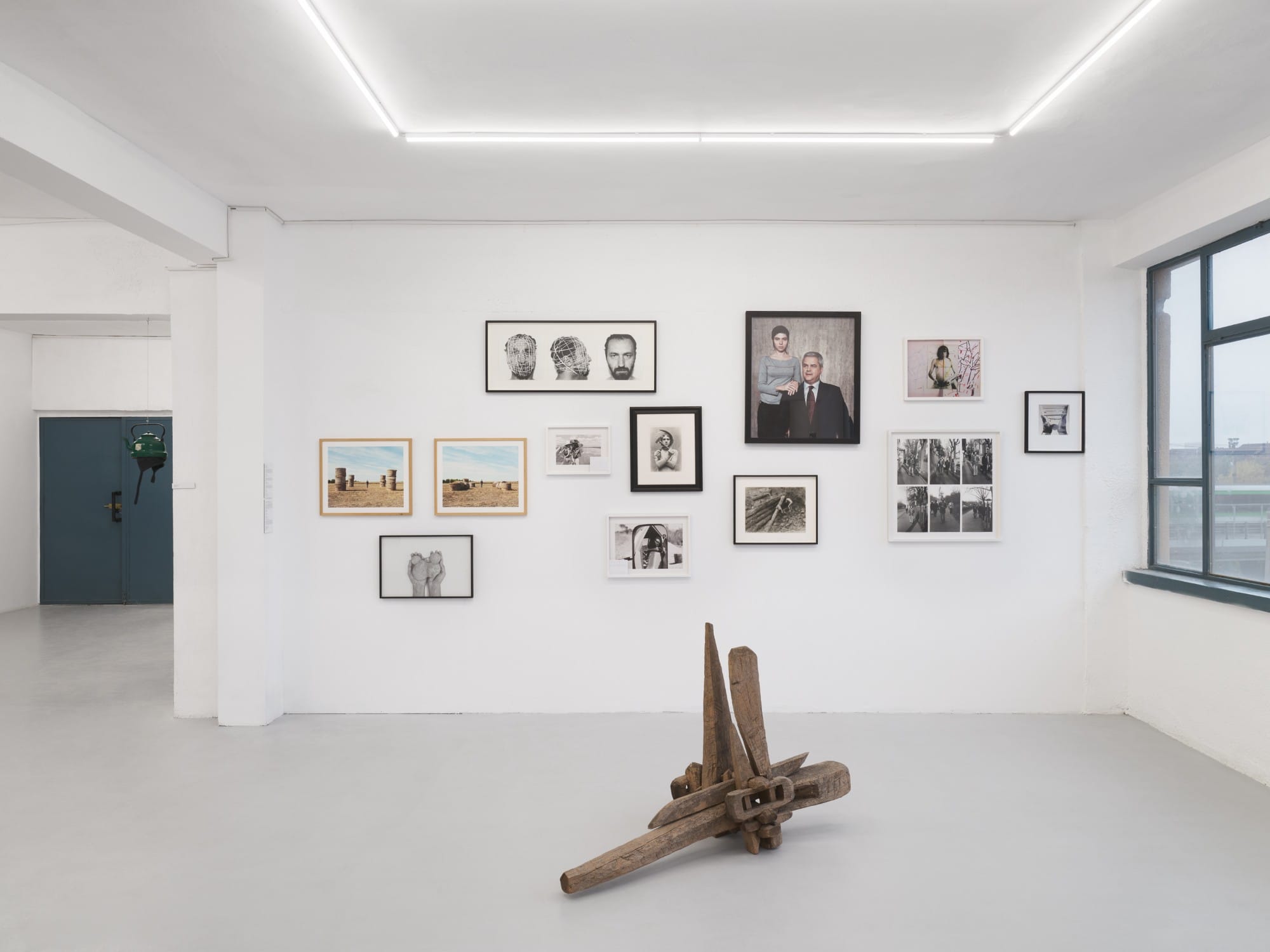
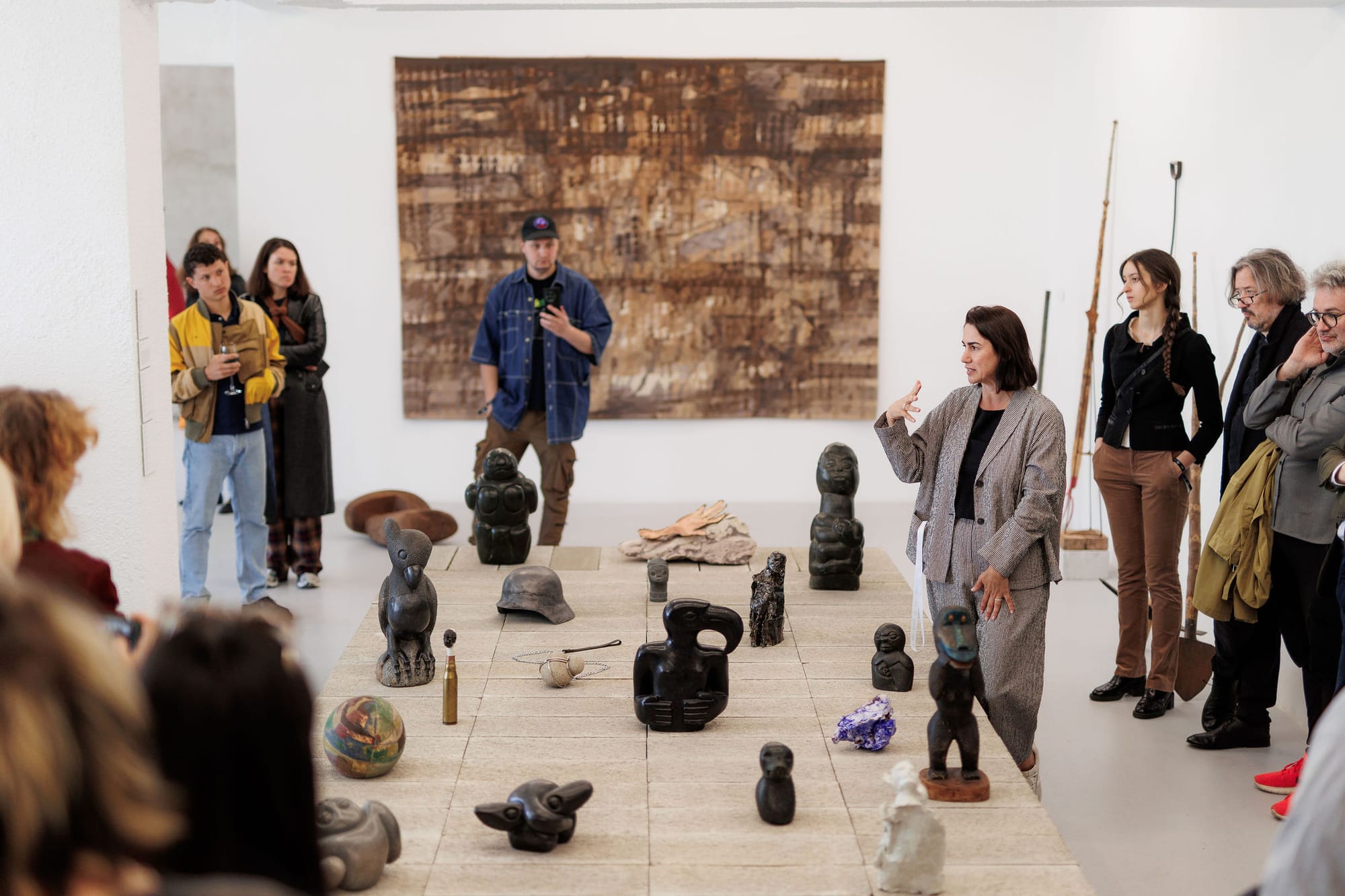
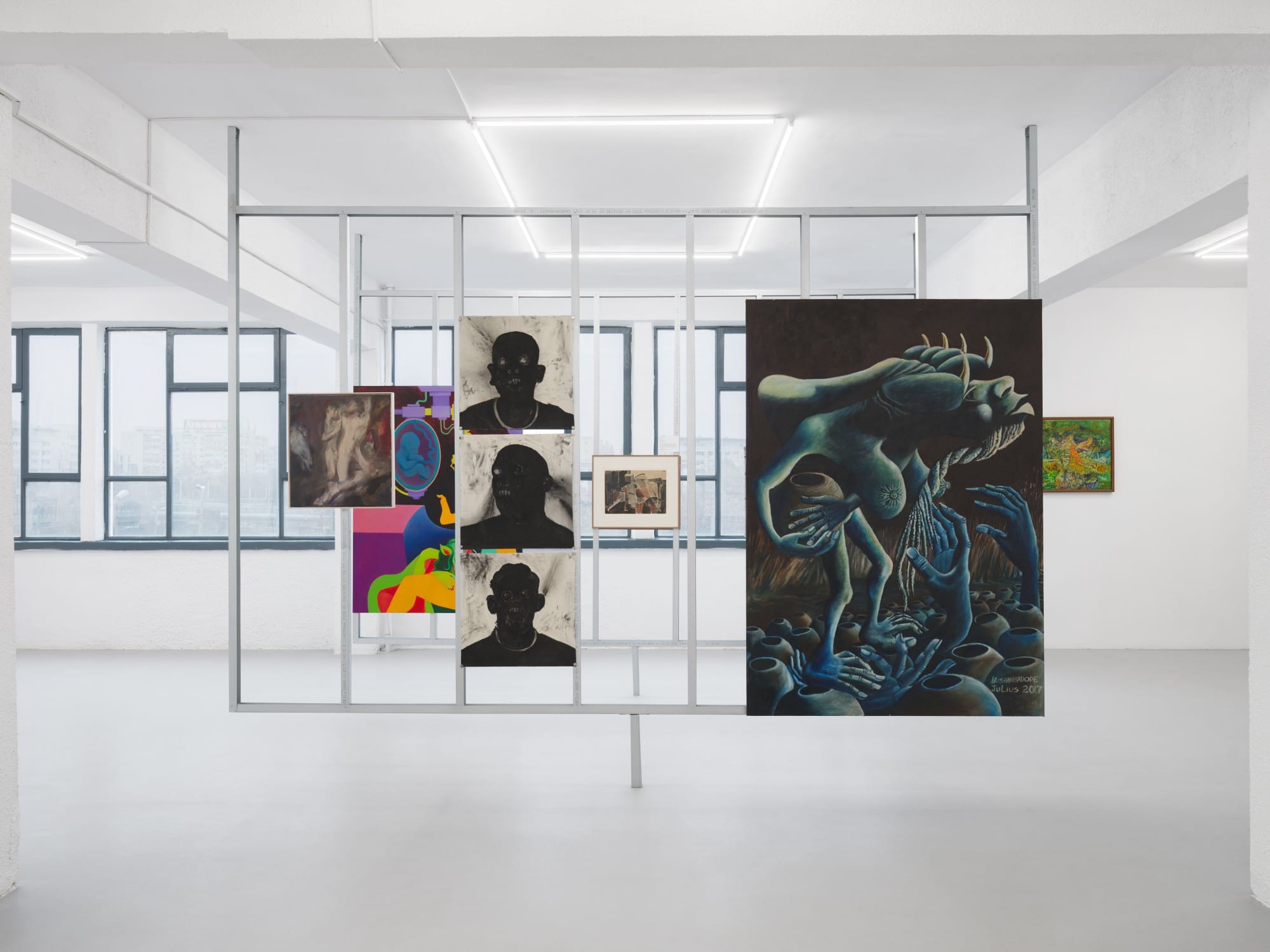
Center: Catinca Tabacaru presents “Have No Doubt of the Omnipotence of a Free People” during visiting curator tour at Catinca Tabacaru Gallery, photo by YAP studio, courtesy of RAD Art Fair [you can see me in middle filming on my phone] - Left & Right: Installation view of exhibition, photos courtesy Catinca Tabacaru Gallery
The show drew criticism from some in Romania for presenting a positive story from the Communist era. But Tabacaru asserts that the exhibition is not taking political sides, but using art as a way to access a lost moment in time. A corpus of newspaper clippings on display shows how the liberation movement in Zimbabwe was presented through a vast array of propaganda in Romania, as well, alongside historic documents pertaining to the relationship between the countries. By presenting both, the message is: some propaganda is actually true. During the run of the exhibition, the gallery hosted a symposium of Zimbabwean and Romanian artists, academics and historians that included voices critical of Ceaușescu while also capable of reconstituting the liberation that his government enabled. The exhibition will travel to The National Gallery of Art Zimbabwe in Harare in 2028—and so a historic relationship will engender an artistic partnership of the future.
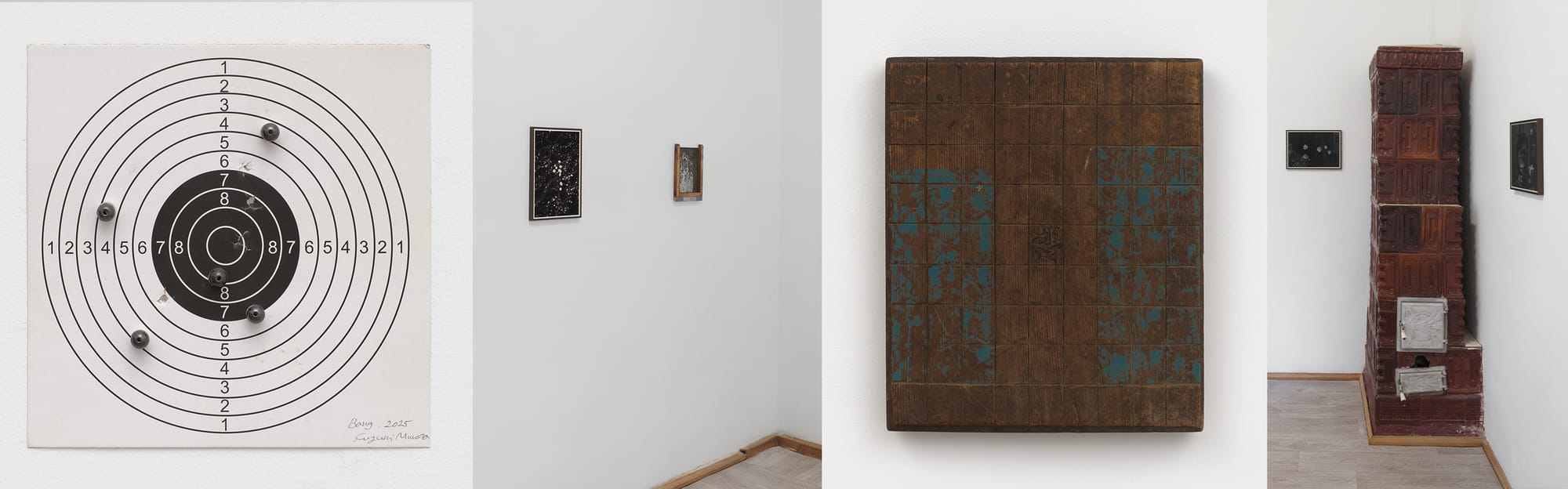
After the fair, I linked up with gallerist, Stefany Lazar, who followed a similar path as Tabacaru but on a smaller scale. Burned out with the grind of NYC life, she moved to Romanian and rented an apartment next to the one her grandmother lived in. She has opened a “NYC style gallery” called S.L.S.R.L. or “Salonul Lucrărilor Selecte Ale Rețelei Lumii Salon” which translates to Salon of the World Network, but also doubles as Stefany Lazar SRL (like LLC), a Bernadette Corporation-esque instinct that I am a sucker for. The gallery is currently showing two Japanese artists, Fuyumi Murata & Fumiaki Nagao. I take in a quiet grace emanating from the works. Murata’s “Bang” offers a shot-through bb-gun target to the curator to place magnetic balls securing it to the wall. The act of mounting completes and captures the work in an ongoing effort by the artist to probe the boundaries of the art object. Nagao’s carefully patterned acrylic pieces resonate the embedded essence of the many hands that have touched an old japanese chess board and a galley letterpress tray. The works pull you in and whisper secrets from past lives or future memories.
Lazar is an art industry professional, taking time out from her demanding photo editing gig to tell me how back in NYC she would never be able to afford a space and run a program like S.L.S.R.L. that brings in international artists and presents a large booth at a national art fair. The now artworld-viral “New York Real Estate and the Ruin of American Art,” essay by Josh Kline is on the tip of our tongues as she describes a book club she runs. It sounds so idyllic, laying about in the small patio outside the gallery, smoking cigarettes (everyone smokes here) and discussing the birth of modernity through the lens of art and philosophy. It’s a little piece of hard-fought utopia and I can’t help but see stars in my eyes.
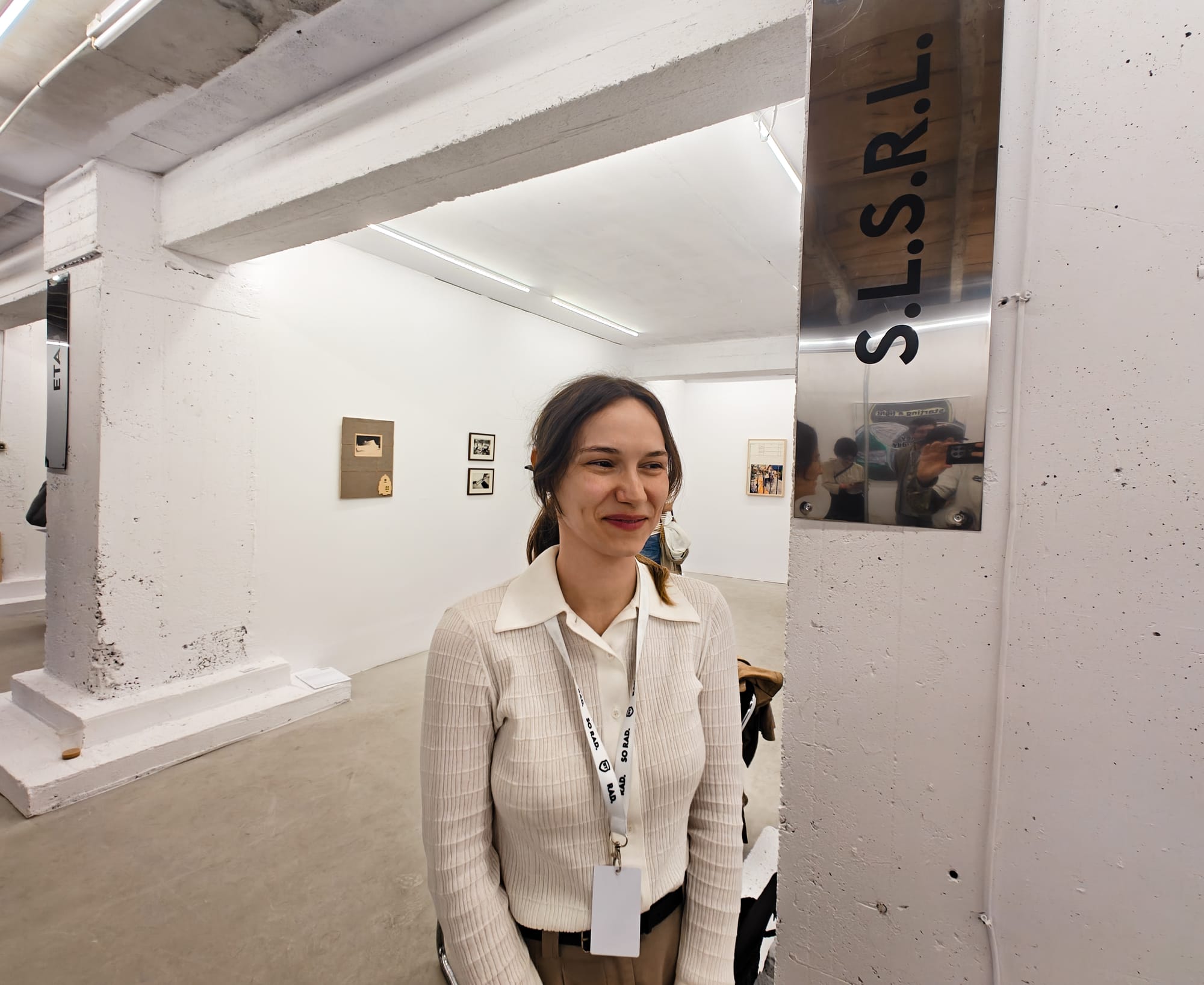
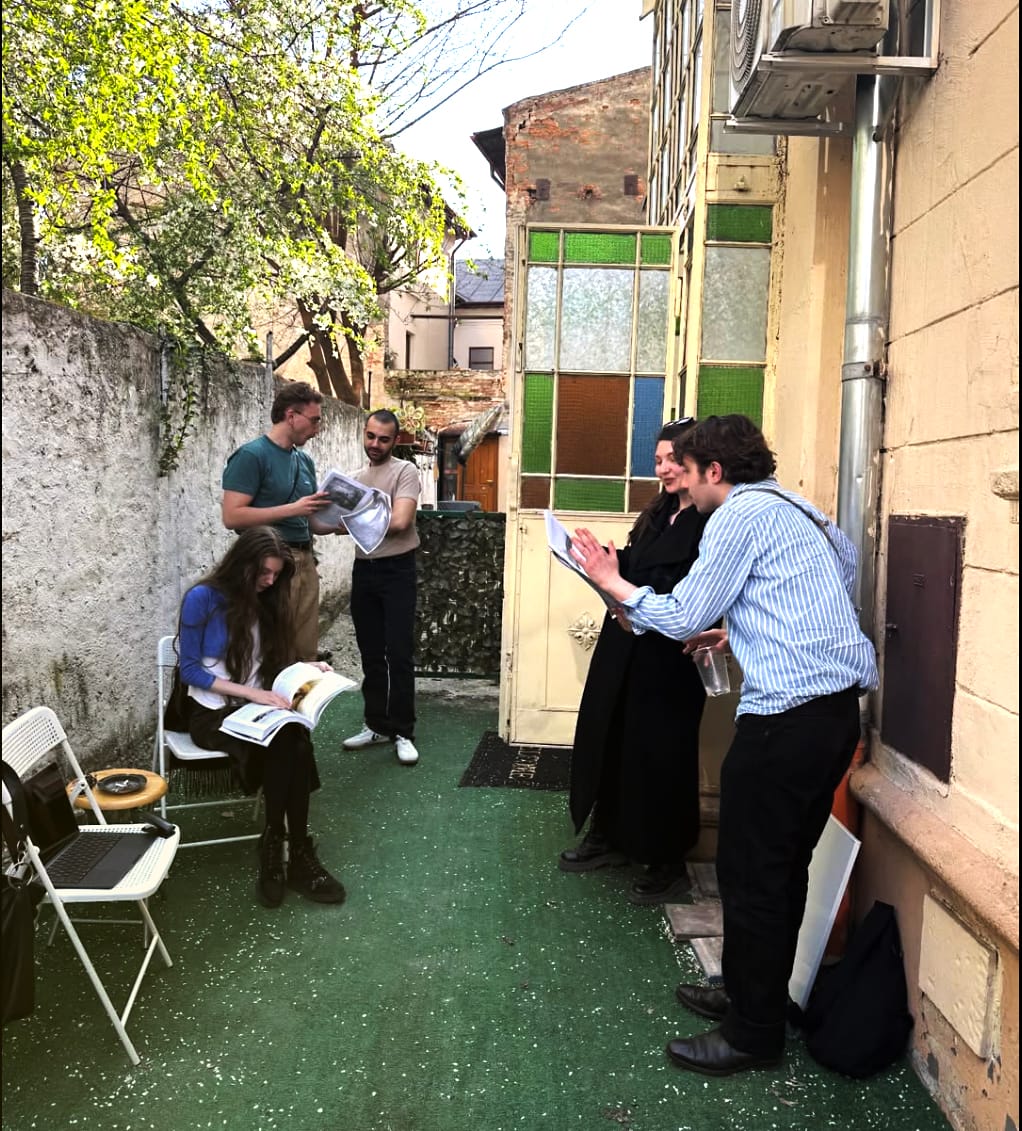
Left: Stefany Lazar at S.L.S.R.L. booth showing the work of Anca Țintea at RAD Art Fair, photo by Jak Ritger - Right: Art History Reading Group on the S.L.S.R.L patio
Catching Romania’s Next Wave
The young artists that I met at the fair completely blew me away. The radical sensibility presented by the fair is being carried forward by a new crop of hungry and “tapped in” creators. I managed to squeeze in a studio visit with, tip of the spear, Andrei Nițu, a painter obsessed with color theory and “finding the essence” within objects, cities and people. His serene and eerie pictures began as carefully staged dramas. He mines interpersonal insecurities, heartbreak or religious symbols and compresses these elements into portrait still life photography to serve as reference.
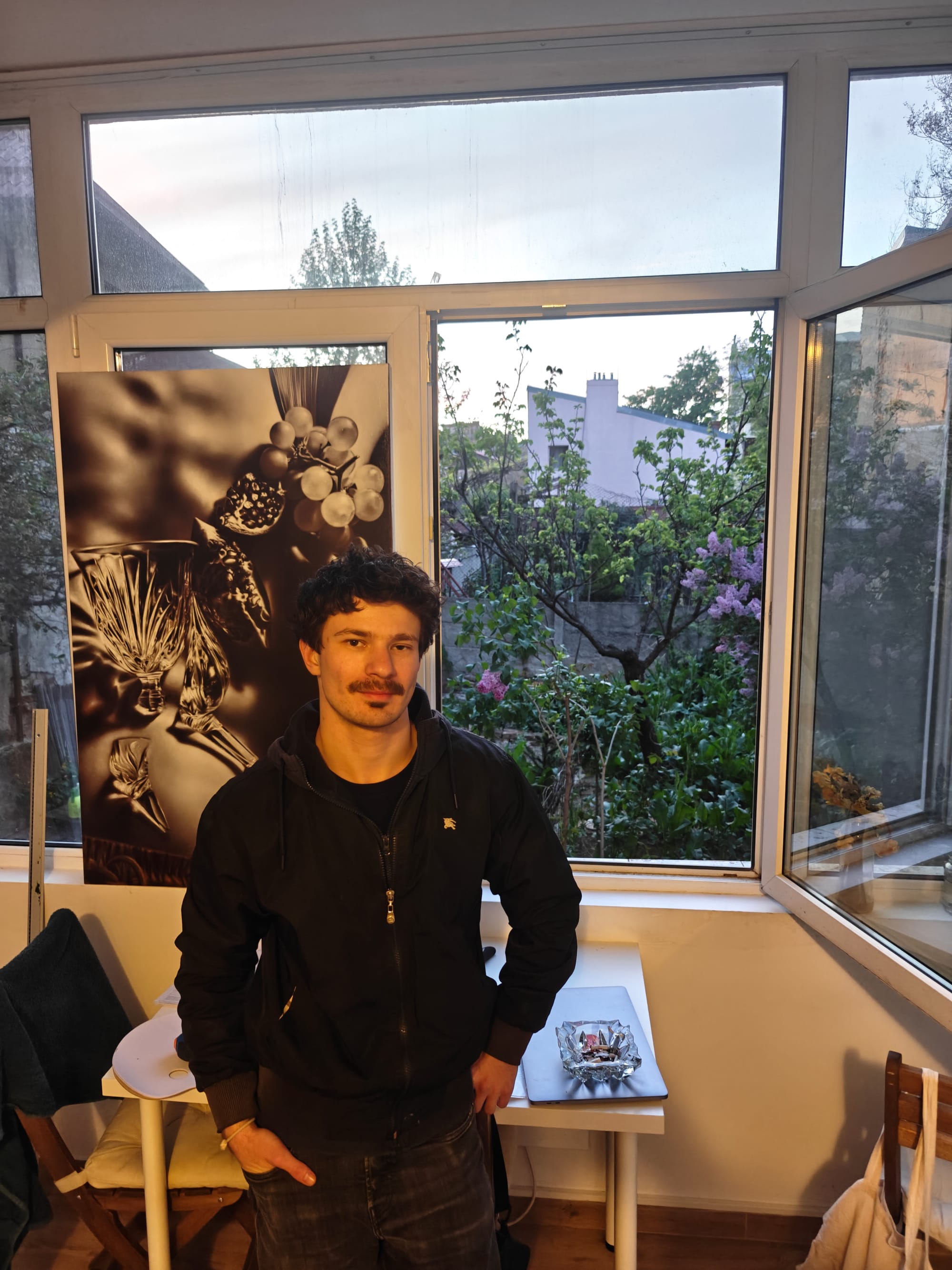
Nițu's paintings shine a dichrome light that is the product of complicated experimentation with a traditional process. The virtuosity of the technique creates a friction with the contemporary styling and details: a vape, leather or a Chinese pendant left behind by a popular influencer friend. All of his subjects are looking to the right, a gesture that symbolized Nițu’s embrace of the future. He embodies the progressive attitude of the youth artists I met, one that is frustrated with dysfunction within the country that they feel is holding it back. We talk about the sense of fashion in Romania and Nițu laments the lack of fashion, “I think we have burned a step.” meaning in the country's quick transitional phase left no time for sartorial aesthetics to coalesce around a specific identity. But, looking at Nițu’s work, it is clear that there is a far-reaching vision for beauty that we would do well to pay close attention to.
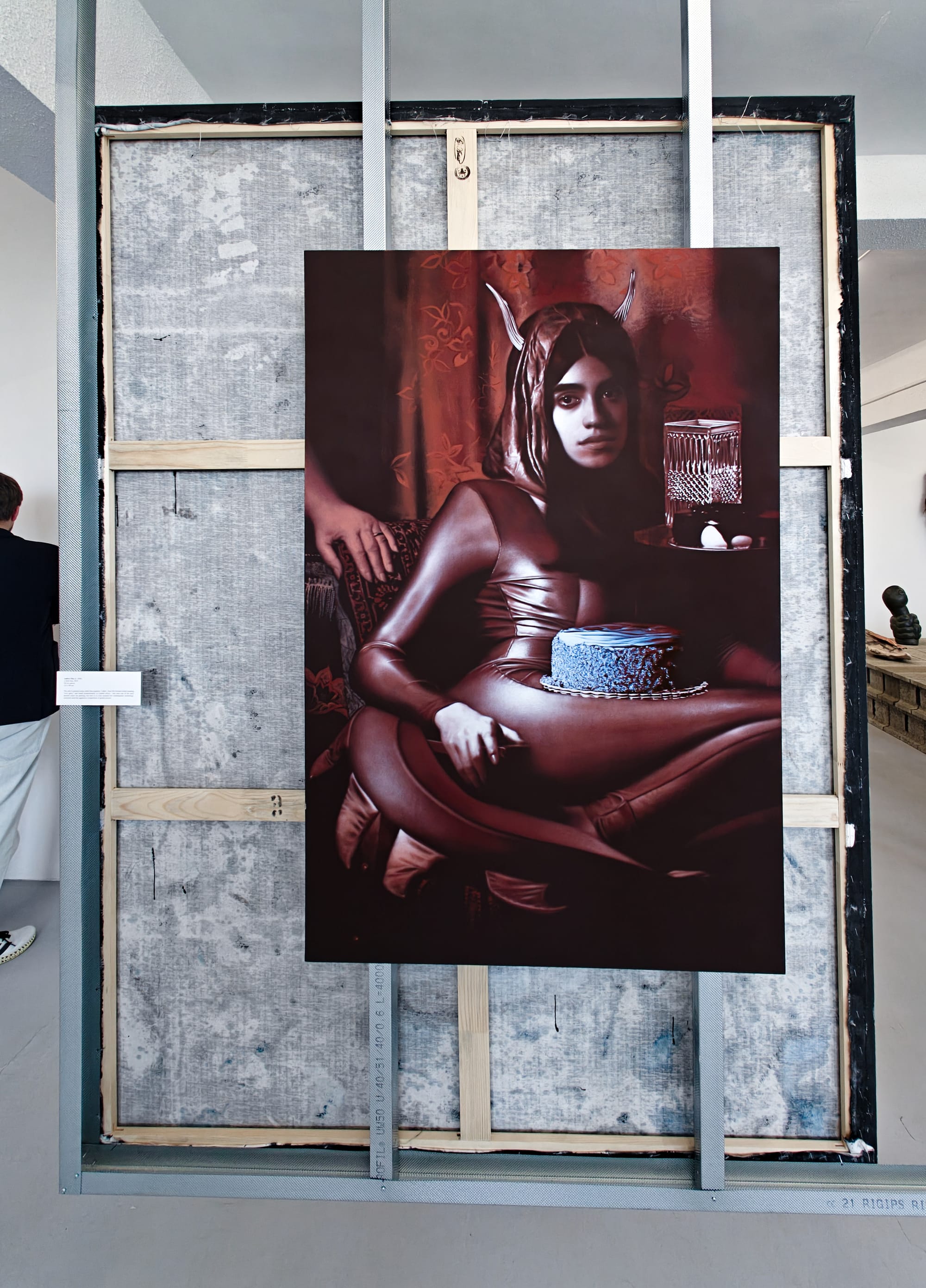
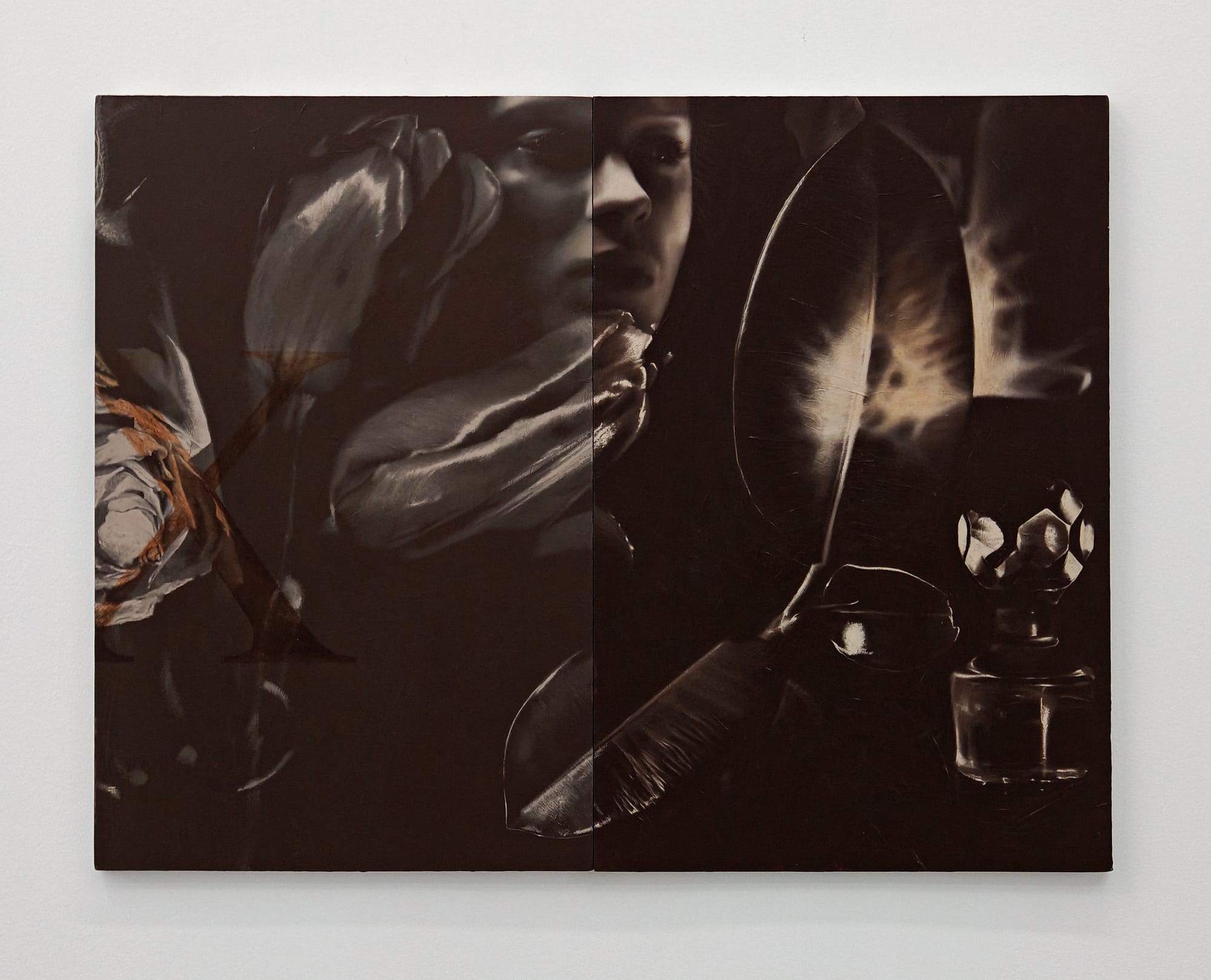
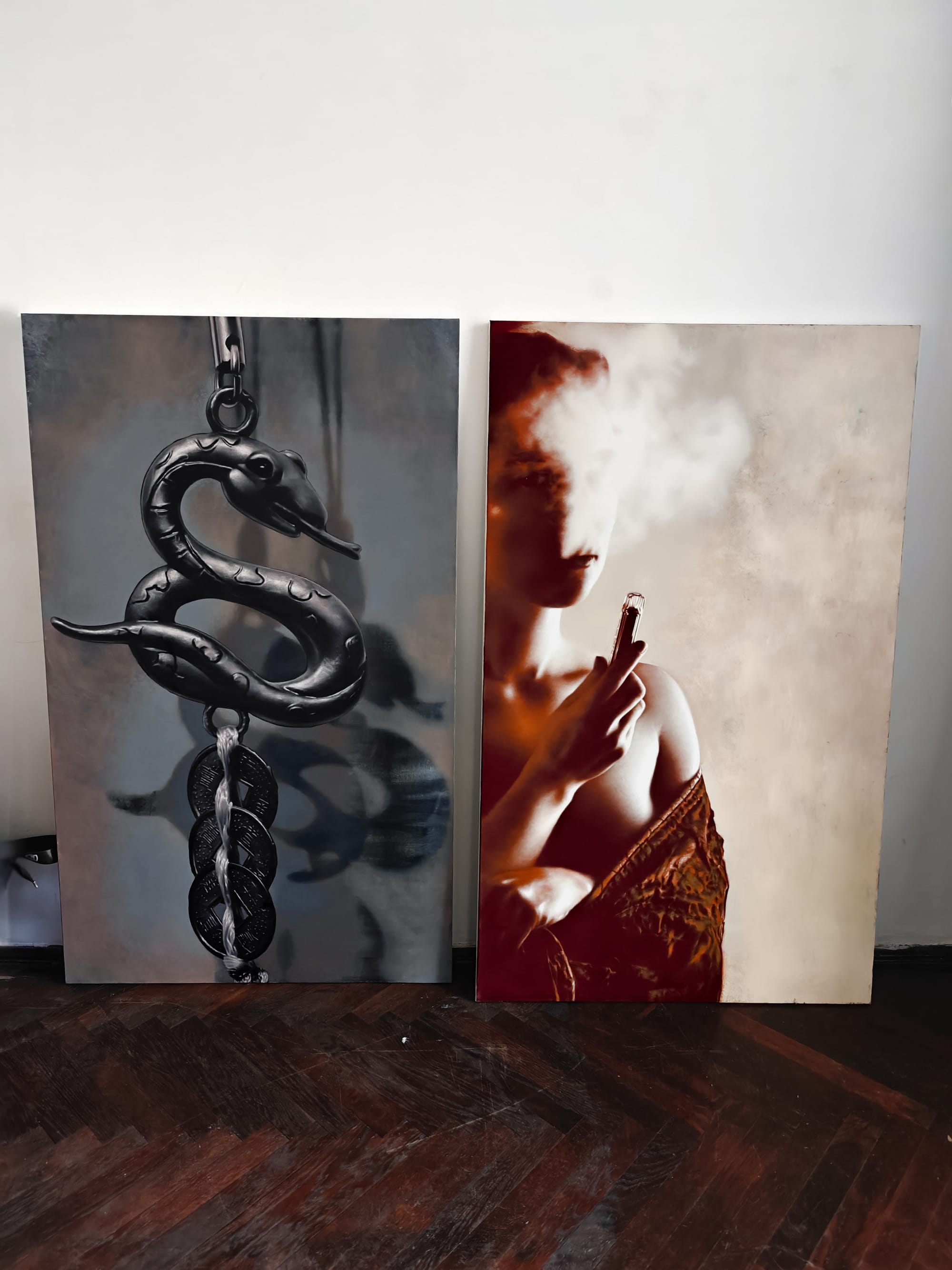
Paintings by Andrei Nițu - Left: “Cobalt Hue (Statecraft)” 80 x 125 cm, oil on linen, (2025) exhibition view, Catinca Tabacaru Gallery - Center: “Harism” 74/51 diptych, oil on panel (2026) Catinca Tabacaru Gallery at RAD Art Fair - Right: “Influencer” (2025) and “Pantocrator no.2" (2026) oil on canvas, 75x125 cm, as seen during studio visit - Photos by Jak Ritger
This restless infectious energy carried through in the discourse program back at the fair. In a stroke of radical curatorship, the fair invited Aaron Moulton to take the stage alongside experimental popstar Dorian Electra and internet culture detective, Günseli Yalcinkaya. The talk delved into conspiracy theories, divination and the psy-ops in the cultural field. Electra's fans show up creating a cozy audience that share a common language of memes and virality. I chat with some of the Electra-heads afterwords and get a sense for the Bucharest alt music / hardcore techno scene. I get put on to the new 2L3y (meaning Doi Lei or two dollars) record "douazeci" (twenty) which has been on heavy rotation in my house.
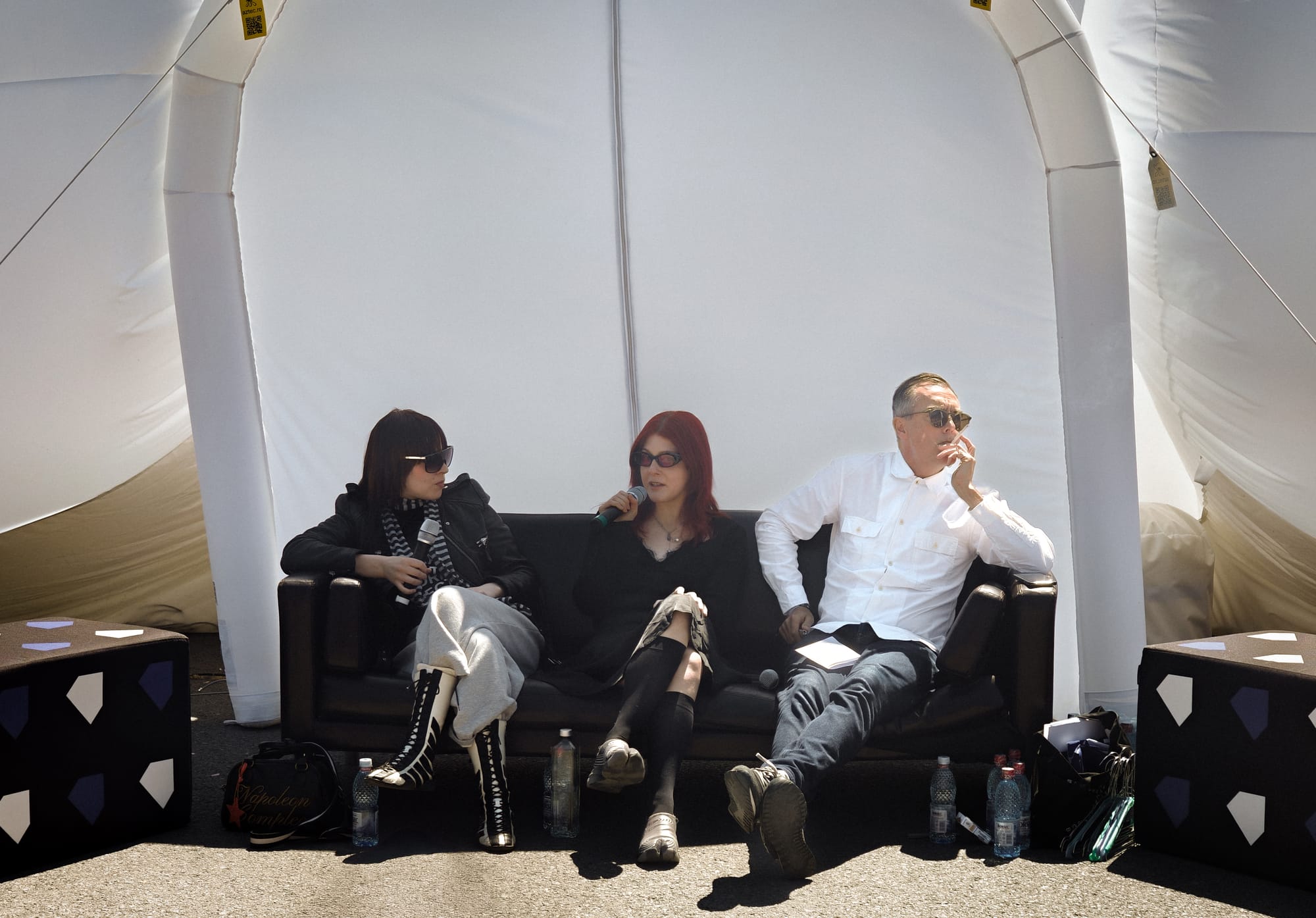
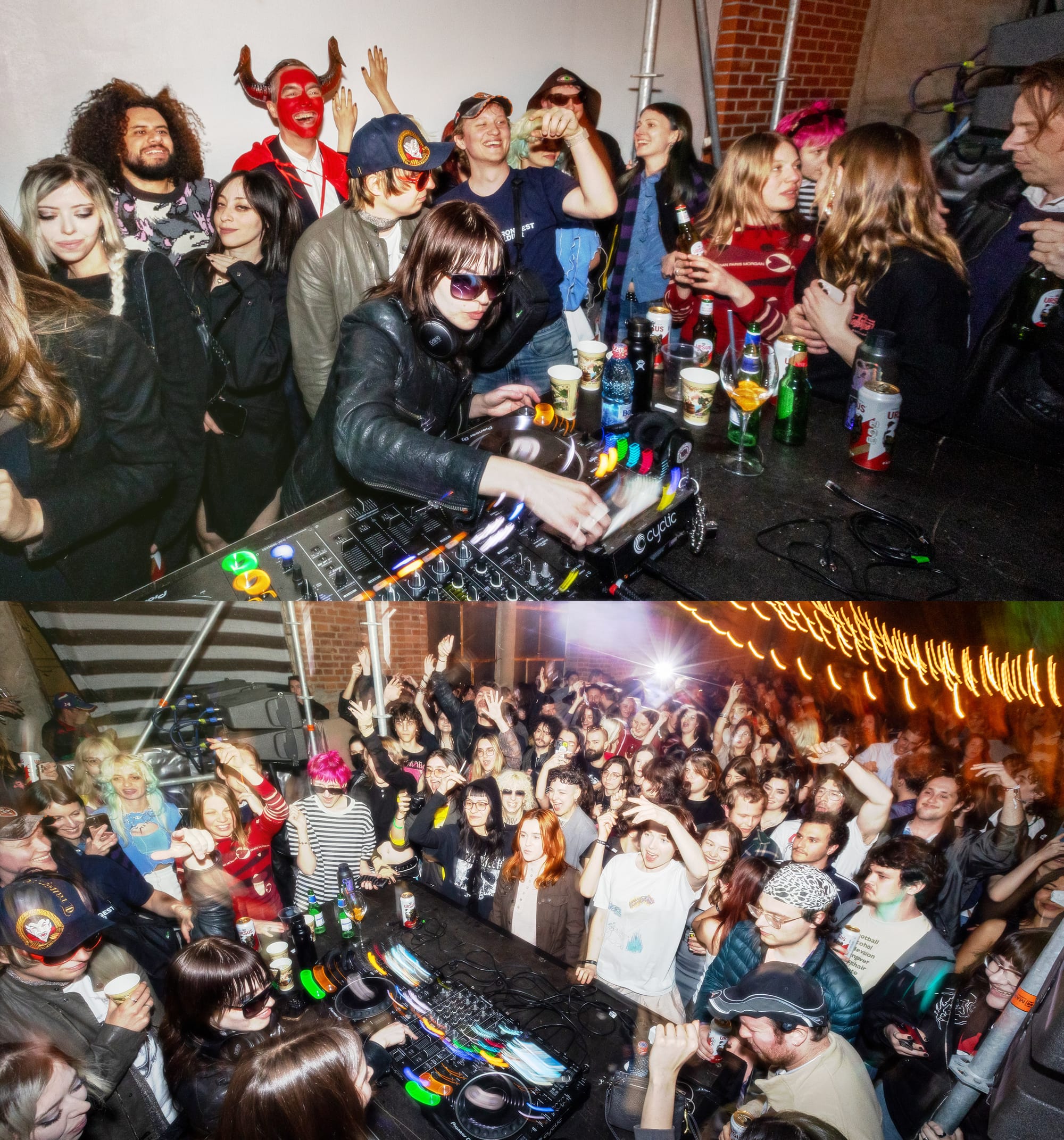
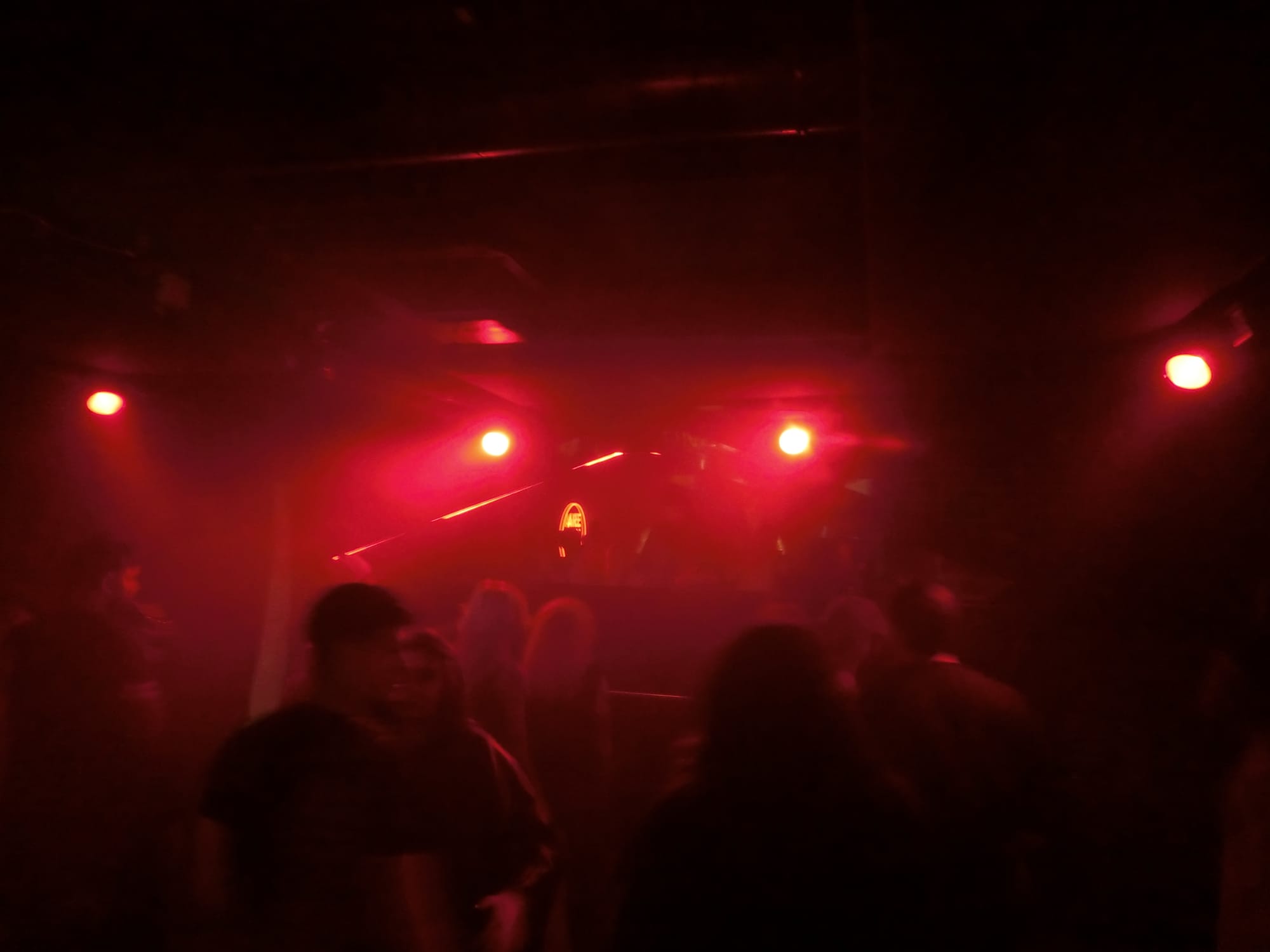
Left: Dorian Electra, Günseli Yalcinkaya & Aaron Moulton present "Storytelling within a Schizophrenic Culture" at RAD Art Fair - Center: Galleries Party with Dorian Electra & Count Baldor, photo by Rares Toma, courtesy RAD Art Fair - Right: Augustine plays at Club Nether, L/R photos by Jak Ritger
Later that night Electra DJ’ed a party at the fair alongside collaborator and super-producer Count Baldor. Between custom DJ tags “THIS DJ SET IS PROUDLY SPONSORED BY THE C.. I… A…” I met IIOANA, a local artist, diy-electronic musician and singer. IIOANA (pronounced like Iguana with no G) tells me about manele music, a pop folk genre of the Roma people, a group that faces discrimination in the country. They explain to me that manele is banned in clubs and on the radio. “If you play it, you will not be allowed back.” They play me their song with manele influences infused with a high-energy candyflipper riff and then drag my whole crew down into a fogged out club called Nether. IIOANA’s friend Augustine is spinning hard techno, latincore and UwUracha. It’s a chaotic and suped up set, I let go on the floor and dance the gabber a bit.
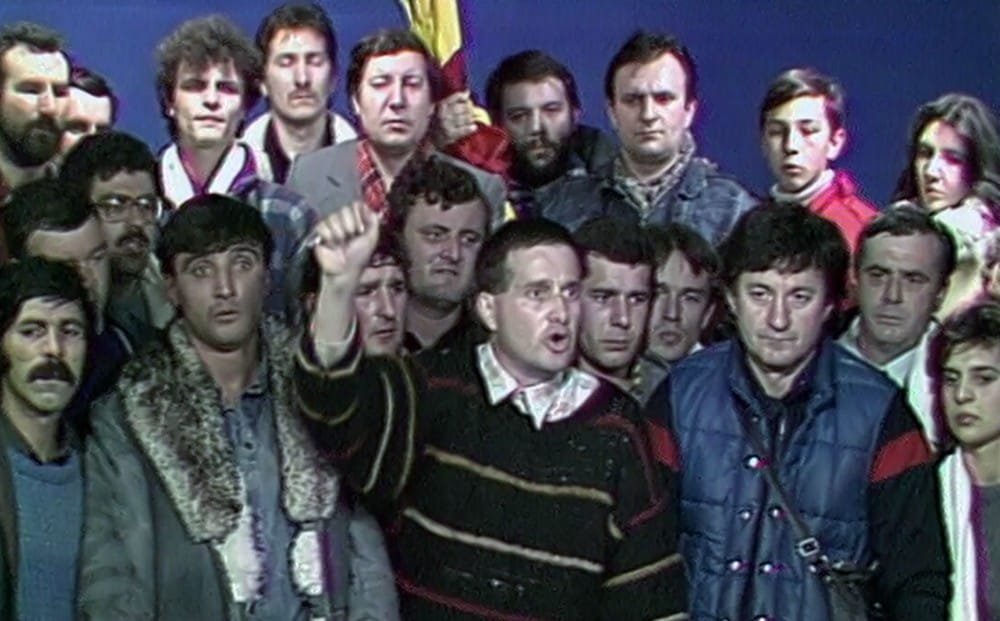
At about 4 am, we take a break, and IIOANA gives me one last deepcut recommendation: a restaurant in the old town owned by Mircea Dinescu, the poet who had a preeminent role in the Romanian revolution of 1989 and can be seen, front and centre, taking over the National Television station in German artist Harun Faroki’s documentary film Videograms of a Revolution (1992). The restaurant is called Lacrimi și Sfinți (“Tears and Saints”). On my last night in the city, I stopped by and enjoyed traditional fish soup and a “postmodern seasoned cured mutton”. The decor has traded traditional taxidermy for Lego busts, and a poem printed on the menu begins, “Kitchens seen from the sky, better than heads of state...”
I decide that the reality of the multipolar artworld is not found in spheres of influence, but in an art scene’s ability to navigate geopolitical complexity and contradiction. The tight-knit tenacity—and perhaps the blackpilled understanding that the State is not there for their help or protection–I found in this scene will likely make it resilient during this current rise of polarization. It’s a lesson we should take to heart in the dog-eat-dog art centers of the West. At the end of my stay in Bucharest, all of the politics, art, struggle, and freedom seem to reduce down into the nuance found in a bite of tangy chop and polenta, cooked up by a revolutionary. Mulțumesc și la revedere.